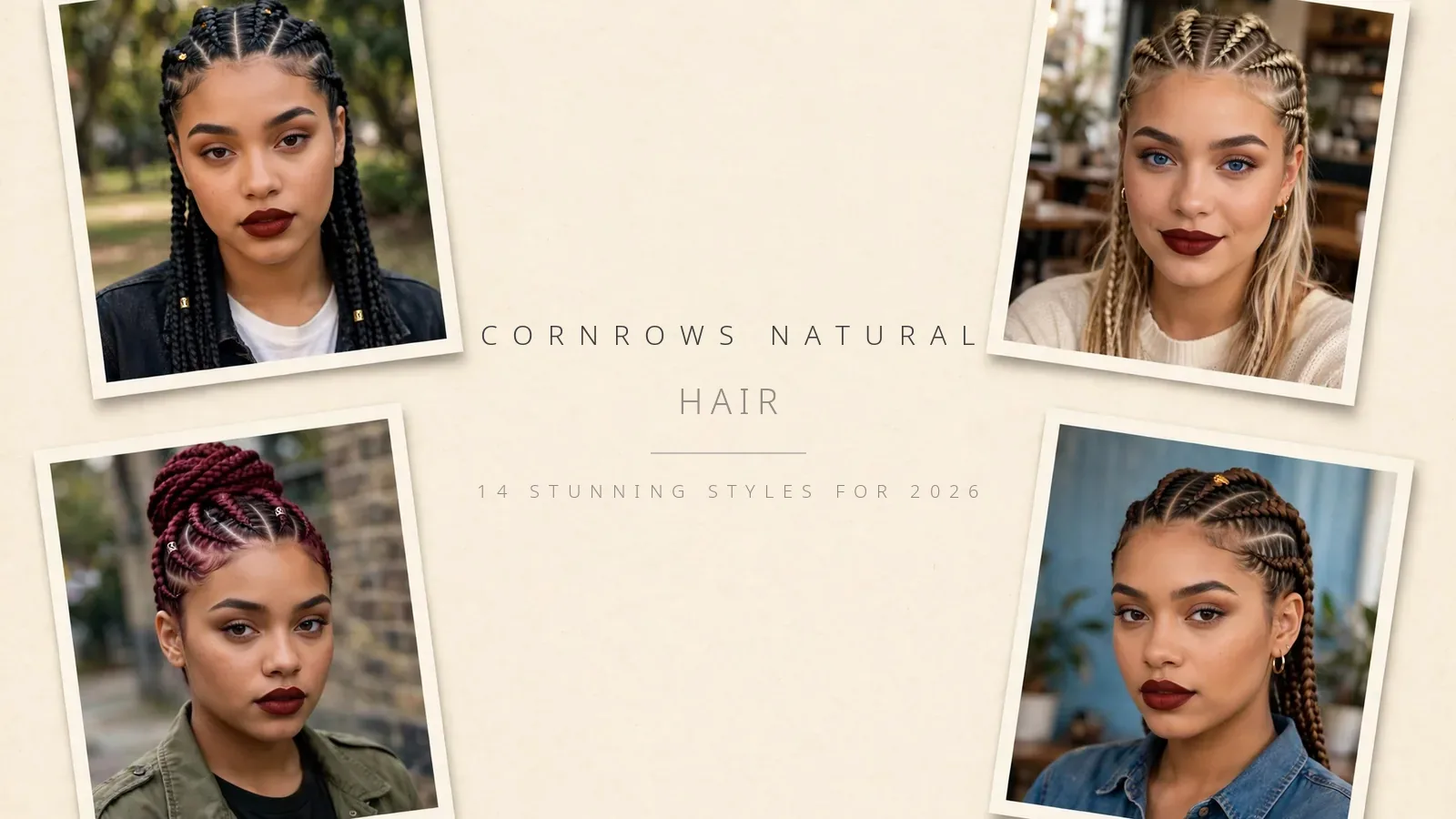
Cornrows Natural Hair – 14 Stunning Styles for 2026
Choosing cornrows should be exciting, but for too many people it ends in regret: a style that looked perfect on someone else pulls their edges, frizzes in a week, or turns takedown into a breakage nightmare. Most cornrow guides are thin photo galleries that never mention the things that actually matter — how long each style lasts, how to wash your scalp with braids in, or what to say when a braider pulls too tight.
This guide fixes that. Below are cornrows natural hair styles worth your time and money — 14 ideas from timeless straight-backs to precision stitch braids — each with honest longevity, edge-safe guidance, and the care routine nobody teaches. Pick the style that fits your hair, your edges, and your life, not just the one with the prettiest photo.
Table of Contents
- 14 Cornrows Natural Hair Ideas Worth Trying
- 1. Classic Straight-Back Cornrows
- 2. Jumbo Cornrows With Curly Ends
- 3. Feed-In Cornrows Into a High Bun
- 4. Side-Swept Cornrows With Curved Parts
- 5. Lemonade Braids With Zigzag Part
- 6. Stitch Braids With Side Part
- 7. Cornrow High Ponytail
- 8. Half-Up Cornrow Space Buns
- 9. Beaded Fulani-Style Cornrows
- 10. Cornrow Bob
- 11. Tribal Pattern Cornrows
- 12. Cornrow Low Bun
- 13. Asymmetric Cornrow Design
- 14. Half Cornrows With Loose Curls
- How to Choose the Right Cornrow Style for Your Hair
- Cornrow Care: Washing, Moisturizing, and Safe Takedown
- What to Tell Your Braider (and Red Flags to Watch For)
- Cornrows Natural Hair FAQs
- How long do cornrows last on natural hair?
- How do I wash my hair with cornrows in?
- Will cornrows damage my edges?
- How short can my hair be for cornrows?
- How do I take cornrows out without breakage?
- Can I work out or swim with cornrows in?
- What is the difference between feed-in and regular cornrows?
- How do I stop my scalp from itching under cornrows?
14 Cornrows Natural Hair Ideas Worth Trying
Every style below is a proven cornrows natural hair idea — worn, tested, and loved by the natural hair community, with honest notes on how long each lasts and who it suits best.
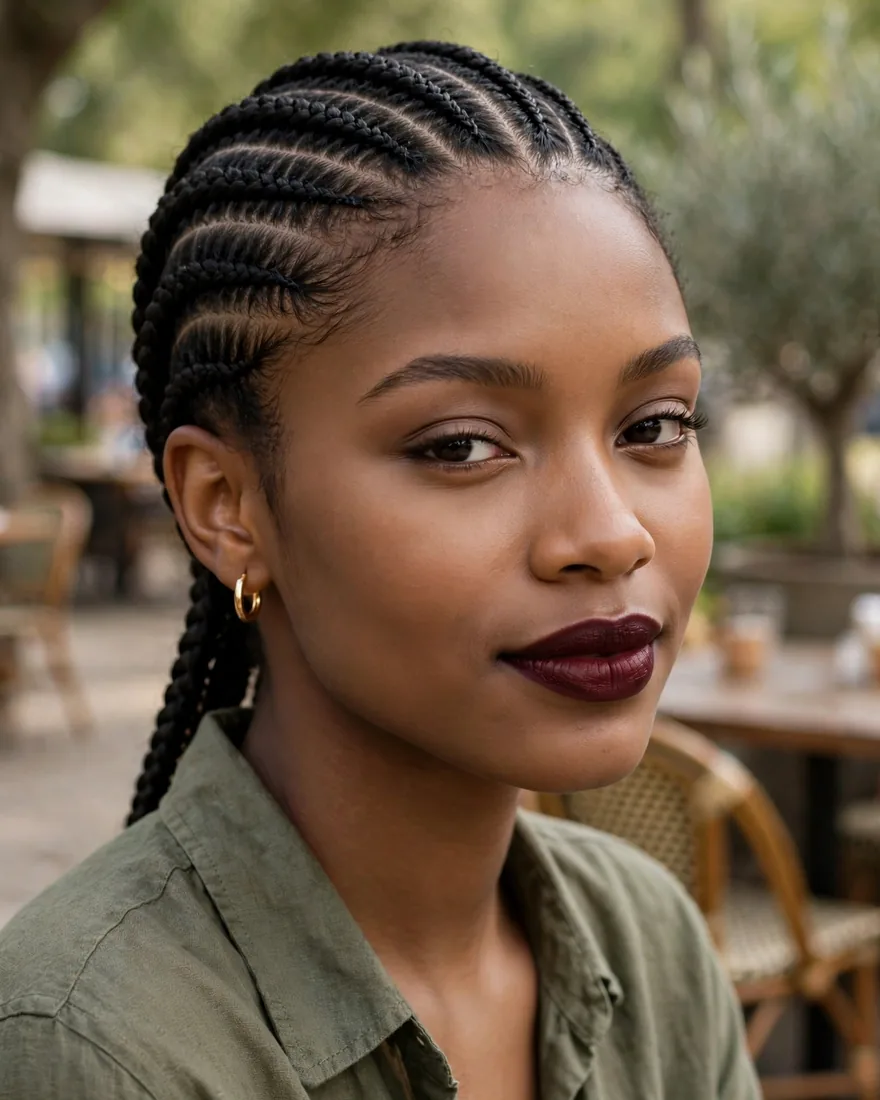
 1. Classic Straight-Back Cornrows
 1. Classic Straight-Back Cornrows
The foundation of every cornrow look: neat, uniform rows braided straight back from the hairline to the nape. This is the style your grandmother wore, the style athletes wear, and the style that never looks dated. It works on its own or as the base under wigs and sew-ins.
Because the pattern is simple, the install is faster and usually gentler than intricate designs. Ask your braider for clean, even parts and consistent tension from front to back.
Among cornrows natural hair styles, this is the one every braider learns first — and the one most clients return to.
Benefits:
- The most versatile cornrows natural hair base — wear alone or under wigs and weaves
- Fastest install of any cornrow style, usually two to three hours
- Even tension distribution makes it one of the gentlest options for edges
Pro Tip: Ask for the rows to start a finger-width behind your hairline rather than right on it — your edges will thank you by week three.
How To Style: Mist the scalp with a light oil every two to three days, tie down with a satin scarf at night, and smooth flyaways with edge control on the parts only.
Best For: First-timers, anyone with fragile edges, and people who want a low-commitment protective style.
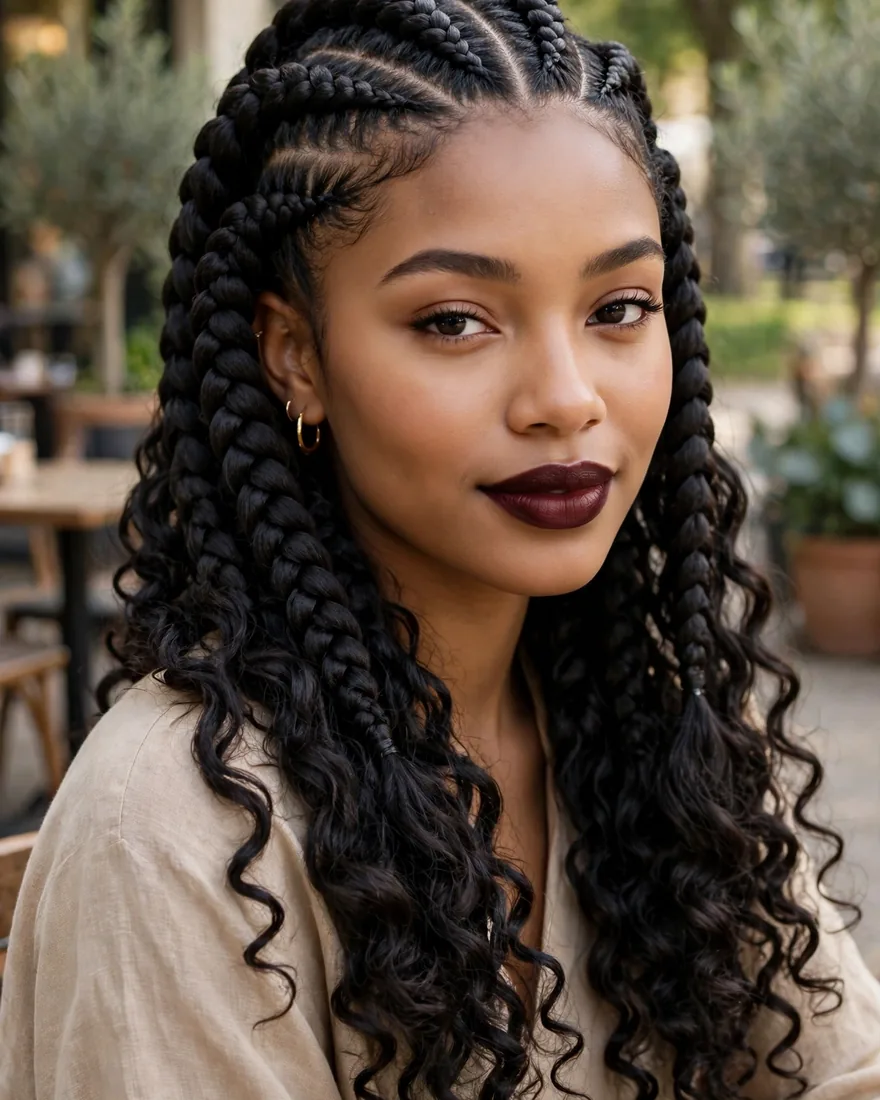
2. Jumbo Cornrows With Curly Ends
 2. Jumbo Cornrows With Curly Ends
Thick, statement-making rows — usually six to eight across the whole head — finished with loose curly ends instead of braided tips. The contrast between the sleek cornrowed scalp and the bouncy curls gives you two textures in one style. It photographs beautifully and takes a fraction of the time small cornrows need.
The curly ends are typically added with braiding hair curled on perm rods or pre-curled extension hair. They need a little more daily attention than tucked ends, but the payoff is a style that looks expensive.
For cornrows natural hair with maximum drama, jumbo rows deliver the most impact per hour in the chair.
Benefits:
- Bold, high-impact look with a much shorter salon appointment
- Curly ends soften the face and add movement
- Easy to refresh — re-curl the ends rather than redoing the whole head
Pro Tip: Have the curly ends sealed with hot water, not just knotted — unsealed curls unravel within days.
How To Style: Each morning, spritz the curly ends with a water and leave-in mix, scrunch gently, and let them air-dry. Pineapple the curls under a satin bonnet at night.
Best For: Thick or medium-density hair; anyone who wants drama without a six-hour appointment.
3. Feed-In Cornrows Into a High Bun
 3. Feed-In Cornrows Into a High Bun
Feed-in cornrows sweep up into a sculpted high bun — the polished, put-together style that works for the office, weddings, and everything between. The feed-in technique adds hair gradually, so there is no bulky knot at the start of each row and no painful pulling at the hairline.
The bun itself can be braided, twisted, or wrapped depending on how formal you want it. This is one of the longest-wearing cornrow updos because the ends are fully tucked away.
This cornrows natural hair updo is the one stylists recommend when the dress code is strict but the style still needs personality.
Benefits:
- Fully tucked ends mean maximum length retention
- Reads polished and professional — no one guesses it is a protective style
- Feed-in technique is noticeably gentler on the hairline than traditional start knots
Pro Tip: Ask the braider to make the bun hollow (braided around, not packed solid) — a dense bun pulls the front rows all day.
How To Style: Smooth the bun with mousse on a soft brush, lay edges with a toothbrush and edge control, and re-wrap the bun’s base if it loosens after week two.
Best For: Anyone who needs a style that survives work, workouts, and events without restyling.
4. Side-Swept Cornrows With Curved Parts
 4. Side-Swept Cornrows With Curved Parts
Instead of running straight back, these cornrows curve in elegant S-shaped parts that sweep everything to one side. The curved parting is the whole trick — it turns a simple style into something that looks custom-designed. The side-swept finish flatters round and square faces especially well.
This style shows off a skilled braider’s hand, so look at parting photos before you book. Clean curves with no wobbles are the mark of experience.
Side-swept cornrows natural hair looks prove that clever parting alone can transform an everyday style.
Benefits:
- Curved parts create the illusion of volume at the crown
- Side-swept finish softens strong jawlines and wide foreheads
- Looks intricate but uses the same technique as straight-backs
Pro Tip: Curved parts show mistakes mercilessly — ask to see the parting before any braiding starts, while it is still easy to fix.
How To Style: Keep the curved parts crisp by smoothing them with a rat-tail comb and a dab of edge control every few days; avoid heavy oils that blur the part lines.
Best For: Round, square, or heart-shaped faces; anyone who wants an everyday style with a designer feel.
5. Lemonade Braids With Zigzag Part
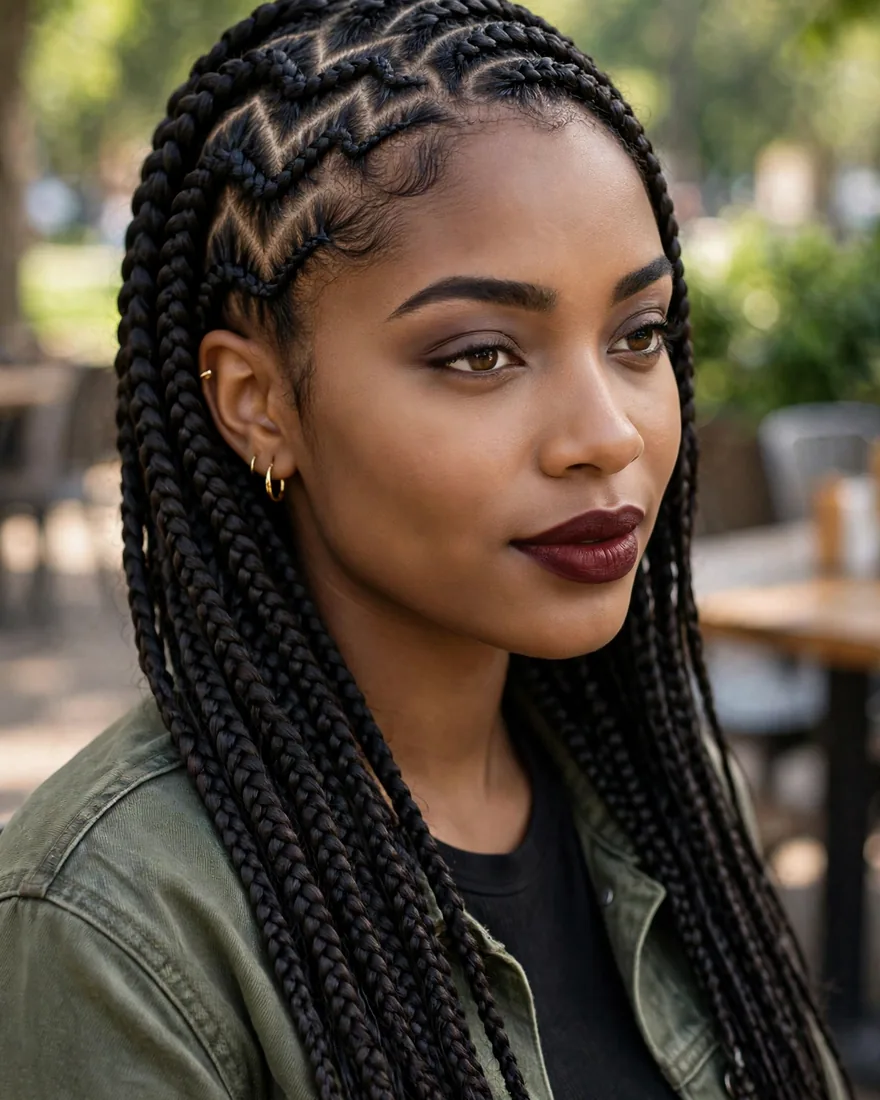 5. Lemonade Braids With Zigzag Part
Made famous on the Lemonade visual album, these are cornrows braided to one side — usually with a deep side part — and this version adds a sharp zigzag part for extra edge. The asymmetry is dramatic, face-framing, and endlessly photographed. Fulani braids share the same side-swept DNA if you want beads with the drama.
The zigzag part needs to stay crisp for the style to read correctly, so this one asks a bit more maintenance than straight rows. Worth it for the compliments.
Lemonade cornrows natural hair styles stay among the most requested in salons year after year — the asymmetry simply works.
Benefits:
- One of the most complimented cornrow styles ever — instantly recognizable
- Side-swept braids elongate the neck and slim the face
- Works at any length from chin to waist
Pro Tip: The zigzag must be carved with a rat-tail comb on stretched, detangled hair — wobbly zigzags ruin the whole effect.
How To Style: Re-trace the zigzag with edge control every two to three days, and sleep with a satin scarf tied snugly so the side-swept braids do not shift overnight.
Best For: Anyone who loves a statement style; great for vacations and events where photos matter.
6. Stitch Braids With Side Part
 6. Stitch Braids With Side Part
Stitch braids use a feed-in technique with precise, thread-like parts that look literally stitched into the scalp. The side part keeps it modern and wearable — less severe than a middle part, more interesting than straight back. Each row is separated by a razor-sharp part that makes the whole head look immaculate.
This is a precision style, so it takes longer and costs more than basic cornrows. The result looks so clean people will assume it is a wig.
Stitch cornrows natural hair installs take longer than basic rows, but the razor-sharp precision lasts for weeks.
Benefits:
- The sharpest, most precise cornrow look available — unmatched neatness
- Stitched parts stay crisp longer than standard parts
- Side part adds softness that flatters most face shapes
Pro Tip: Stitch braids demand a specialist — ask specifically how many sets they do per week, and walk away if the answer is vague.
How To Style: Do not oil the parts heavily; it blurs the stitch definition. Use a light scalp serum on a nozzle applicator and keep hands off the rows.
Best For: Anyone who values precision over speed; ideal if your style leans sleek and minimal.
7. Cornrow High Ponytail
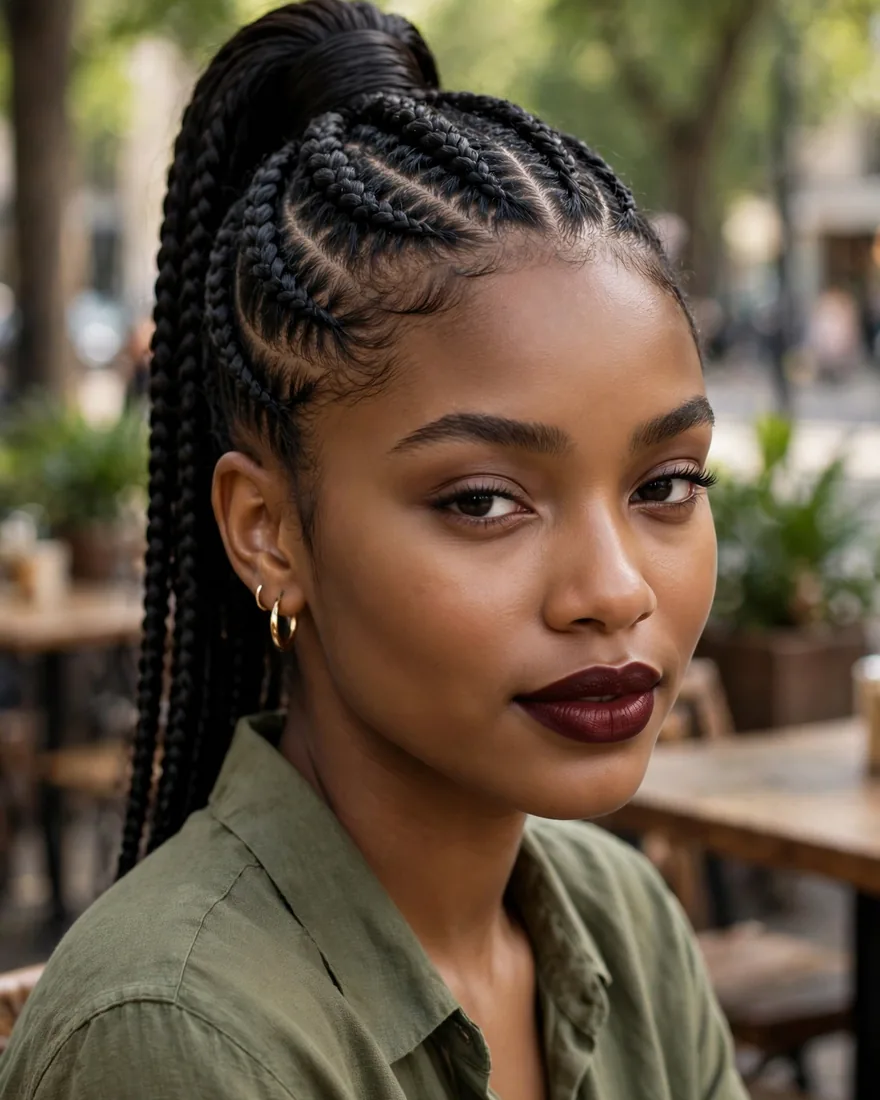 7. Cornrow High Ponytail
Cornrows braided upward into a high, snatched ponytail — the sporty-glam hybrid that never misses. The rows can run straight back, curve, or feed into stitch patterns; the ponytail itself can be braided, curled, or left as a sleek wrapped tail. It lifts the whole face and shows off earrings beautifully.
The tension question matters most here: a ponytail pulls everything toward one point, so the install must be firm but never painful.
A high ponytail is the sportiest of all cornrows natural hair ideas, and the most practical for active days.
Benefits:
- Instant facelift effect — the upward pull lifts cheeks and eyes
- Keeps hair completely off the neck in heat and during workouts
- Ponytail can be restyled (curly, braided, straight) without touching the cornrows
Pro Tip: If your temples throb when the ponytail is pulled up, it is too tight — ask the braider to loosen the perimeter rows before you leave the chair.
How To Style: Wrap the ponytail base nightly to prevent frizz, moisturize the scalp with a nozzle bottle, and switch the ponytail position slightly every few days to vary tension.
Best For: Active lifestyles, hot climates, and anyone who loves a bold, lifted silhouette.
8. Half-Up Cornrow Space Buns
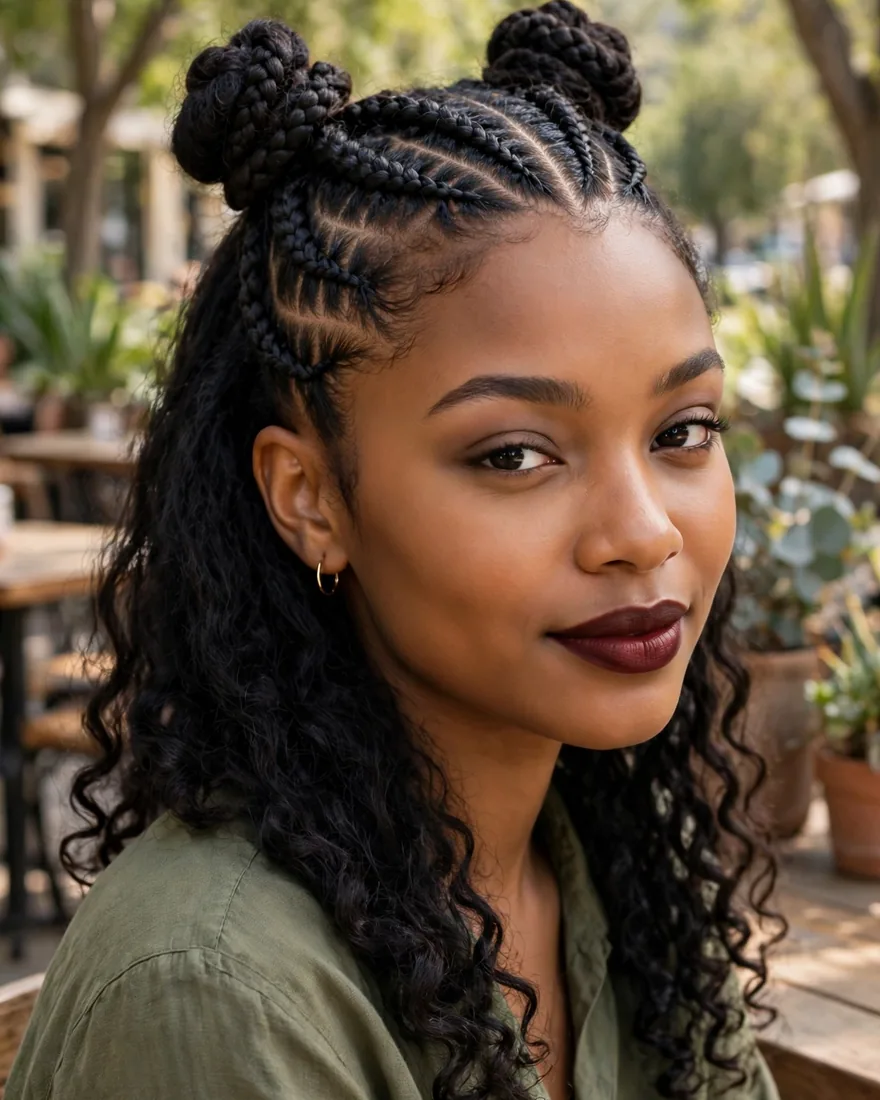 8. Half-Up Cornrow Space Buns
Cornrows on the bottom, two playful space buns on top — the festival-ready style that broke out of Coachella and never left. The cornrows keep the base neat and long-wearing while the buns add all the personality. It works with braided buns, curly buns, or buns wrapped around donut forms.
This is secretly one of the most practical styles here: the buns take the weight off your neck, and the whole thing survives dancing, wind, and long days.
Space buns make cornrows natural hair feel playful and youthful without sacrificing the neatness of the base.
Benefits:
- Playful and youthful without sacrificing neatness
- Buns distribute weight so the style feels light
- Endlessly customizable — add cuffs, string, or beads to the buns
Pro Tip: Make the buns from the top half only and keep them small — oversized buns pull the front cornrows and cause headaches.
How To Style: Re-do the buns every two to three days (takes five minutes), smooth the cornrow base with mousse, and add fresh accessories when the originals dull.
Best For: Festivals, vacations, and anyone under thirty at heart who still wants a protective style.
9. Beaded Fulani-Style Cornrows
 9. Beaded Fulani-Style Cornrows
Fulani-inspired cornrows with a center braid down the middle, cornrows on the sides, and beads, cuffs, and cowrie shells decorating the lengths. It is the most adorned style on this list — part hairstyle, part jewelry. If you love the beaded look, our dyed locs styles show how color and accessories transform braided hair too.
The accessories add weight, so the cornrow base must be secure but not strangling. This style turns heads in the best way and photographs like a dream.
Beaded cornrows natural hair styles carry the deepest cultural roots of anything on this list.
Benefits:
- The most decorative option — beads and shells make it red-carpet ready
- Accessories are reusable across installs
- Center-braid layout flatters oval and long faces
Pro Tip: Thread beads onto the braids before the ends are sealed — adding them afterward means undoing finished work.
How To Style: Remove heavy beads before sleeping or workouts to protect the braids’ tension; wipe cuffs and shells with a dry cloth so they keep their shine.
Best For: Special occasions, cultural celebrations, and maximalists who treat hair as art.
10. Cornrow Bob
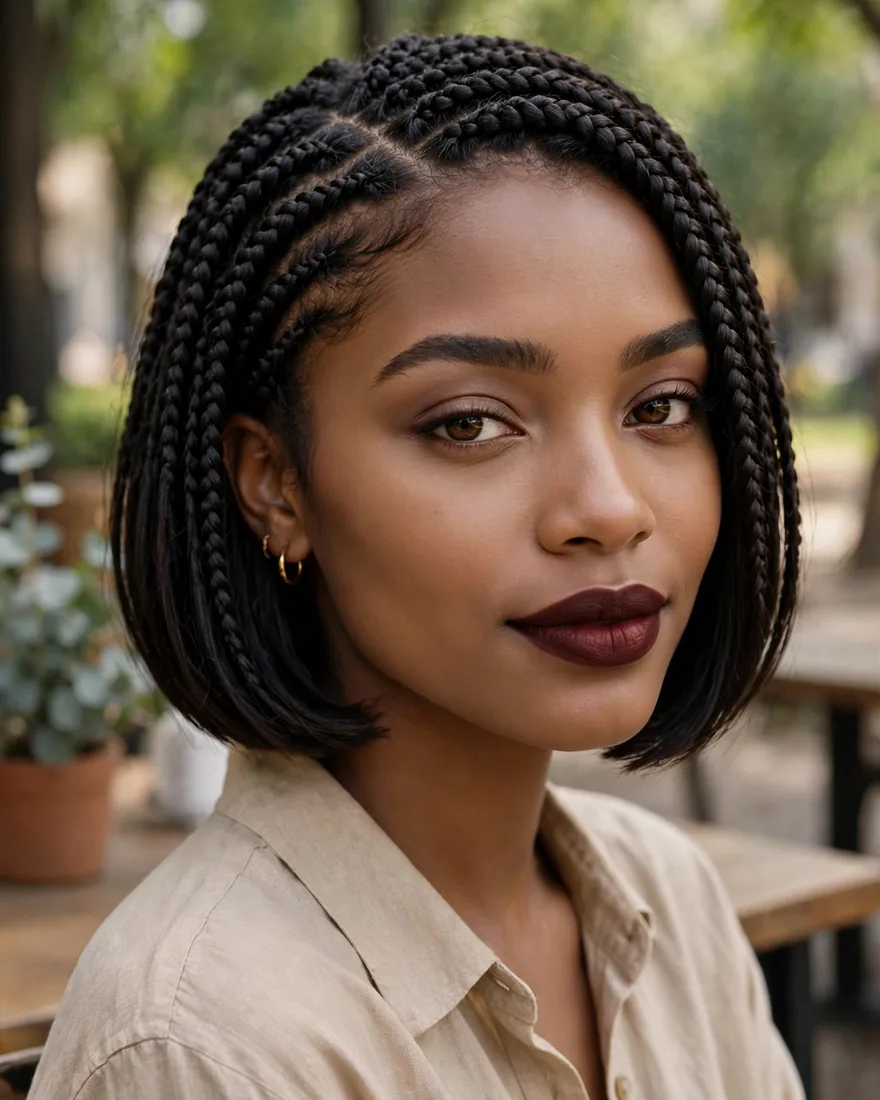 10. Cornrow Bob
All the neatness of cornrows, cut to a chin- or shoulder-grazing bob silhouette. The rows usually run straight back or curve, and the ends are tucked, curled, or blunt-cut to form the bob shape. It is the most office-friendly style on this list — polished, contained, and quietly chic. For a curly take on short braided hair, see short curly hairstyles.
The bob length means less weight pulling on your scalp, which makes this one of the most comfortable long-wear options.
The bob is the most wearable of all cornrows natural hair styles for conservative workplaces.
Benefits:
- Lightest-feeling cornrow style — minimal weight on the scalp
- Reads professional in conservative workplaces
- Grows out gracefully since the silhouette stays intact
Pro Tip: Ask for the bob ends to be blunt-cut after braiding rather than tucked — tucked ends puff out within a week on this length.
How To Style: Smooth the bob silhouette with mousse and a soft brush every few days; re-curl or re-trim the ends at week three to keep the shape sharp.
Best For: Professionals, anyone with neck or scalp sensitivity, and first-time braid wearers nervous about weight.
11. Tribal Pattern Cornrows
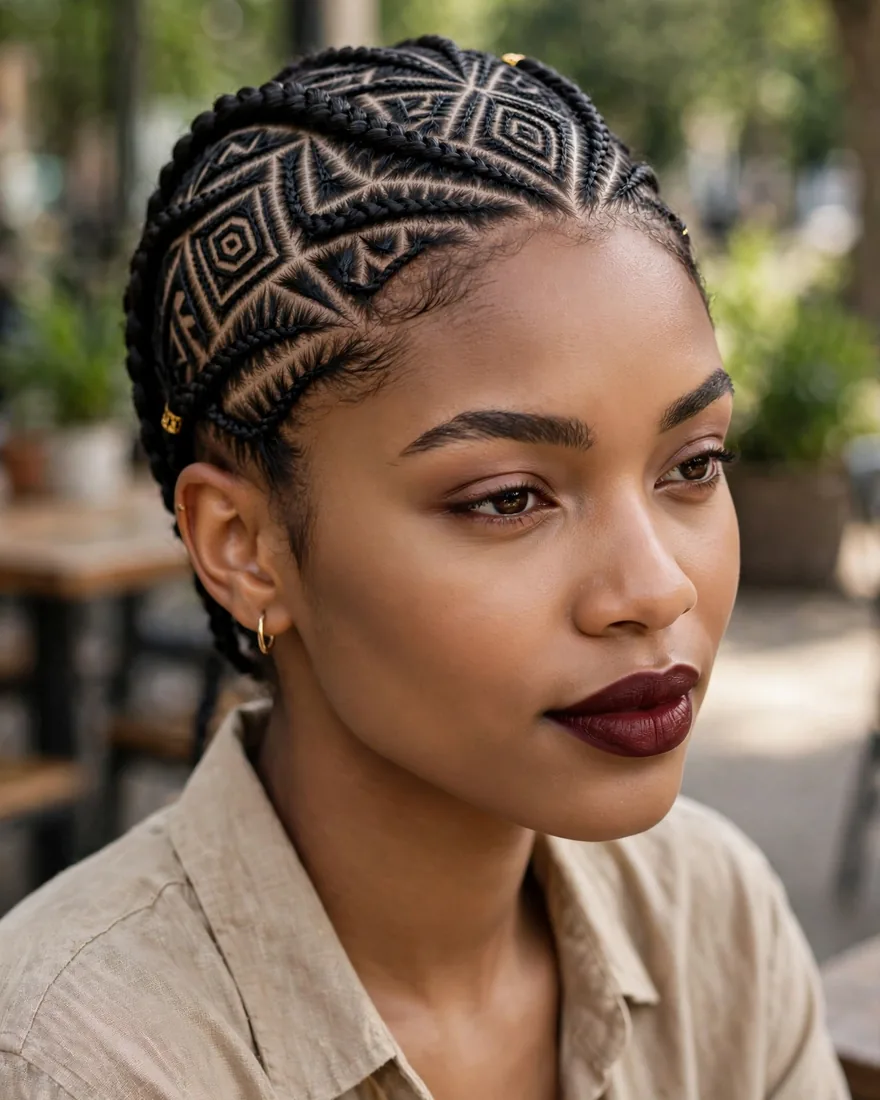 11. Tribal Pattern Cornrows
Intricate geometric patterns — triangles, diamonds, and swirling motifs — carved into the scalp with cornrows following the design lines. This is wearable art and the clearest display of a braider’s skill. No two installs look exactly alike, which is the entire point.
Expect the longest appointment and the highest price on this list. You are paying for artistry, and it shows.
Tribal cornrows natural hair designs are wearable art — no two installs ever match.
Benefits:
- Completely one-of-a-kind — no one else will have your pattern
- Showcases elite braiding skill; a true statement piece
- Photographs spectacularly from above and behind
Pro Tip: Bring three reference photos and discuss which pattern suits your head shape — some geometries flatter round heads, others elongate them.
How To Style: Protect the pattern’s crispness by avoiding heavy products on the scalp; cleanse with diluted shampoo on an applicator bottle so the design lines stay sharp.
Best For: Anyone celebrating something — weddings, graduations, milestone birthdays — or collectors of statement hair.
12. Cornrow Low Bun
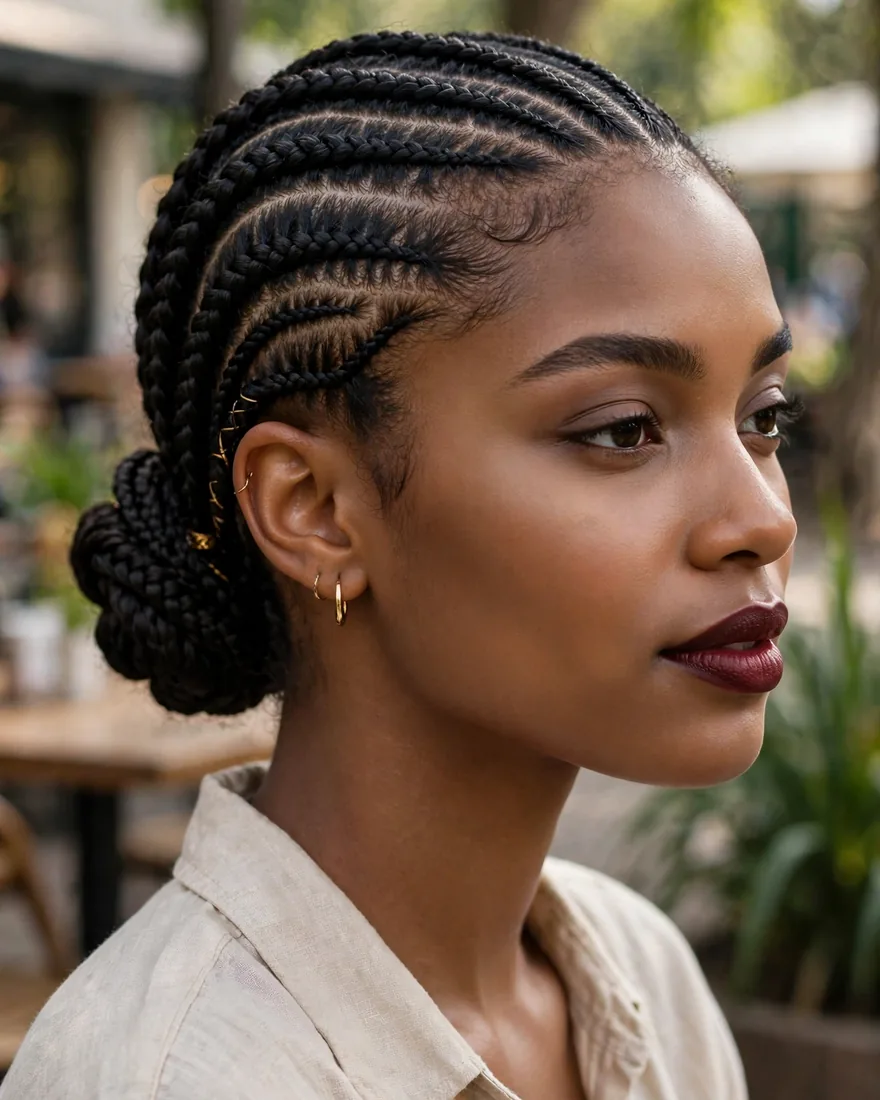 12. Cornrow Low Bun
Cornrows gathered into a low bun at the nape — understated, elegant, and the kindest style here for fragile edges. With no upward pulling and the weight resting low, tension headaches are practically impossible. It is the style to choose when your hair needs a break but you still want to look finished.
The low bun suits every setting from boardrooms to brunch. Add a middle or side part at the front to change the mood.
For fragile edges, low-bun cornrows natural hair styles are the safest choice you can make.
Benefits:
- The lowest-tension cornrow style — ideal for recovering edges
- Timelessly elegant; never looks overdone
- Bun can be dressed up with pins, cuffs, or a silk scarf
Pro Tip: Keep the nape rows slightly looser than the crown rows — the nape is where tension headaches start.
How To Style: Re-smooth the bun weekly with gel and a soft brush, moisturize the nape area well (it dries first), and sleep with the bun in a loose satin bonnet.
Best For: Anyone with tension sensitivity, thinning edges, or a conservative dress code.
13. Asymmetric Cornrow Design
 13. Asymmetric Cornrow Design
Deliberately uneven: cornrows of different sizes, directions, or lengths creating an avant-garde, editorial finish. One side might be micro-rows while the other runs jumbo, or the pattern might shift direction mid-scalp. It is the fashion-week take on cornrows — not for the shy.
This style lives or dies on the braider’s eye, so choose someone whose portfolio already shows asymmetric work.
Asymmetric cornrows natural hair looks are the fashion-week outliers of the braid world.
Benefits:
- High-fashion edge no symmetric style can match
- Asymmetry draws the eye strategically — great for editorial shoots
- Conversation starter; genuinely unforgettable
Pro Tip: Asymmetry still needs balance — the design should feel intentional, not like the braider lost track of the pattern.
How To Style: Treat each section according to its size (mist small rows more often), and photograph the style from multiple angles at install so you can check the design stays true.
Best For: Creatives, performers, and anyone whose personal style runs bold and architectural.
14. Half Cornrows With Loose Curls
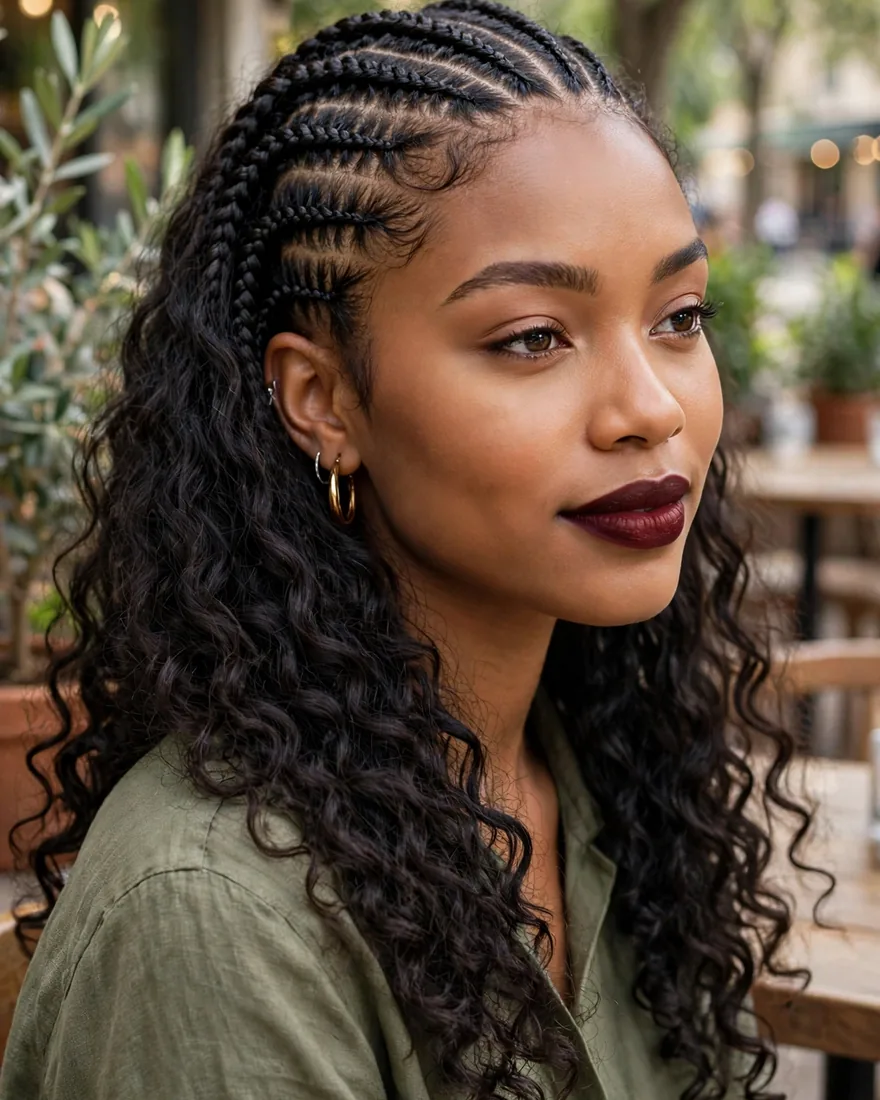 14. Half Cornrows With Loose Curls
Cornrows across the front half or crown, with the back left as loose, flowing curls — the best of both worlds. You get the neatness and edge control of cornrows where it shows most, plus the softness and movement of curls everywhere else. It is romantic, versatile, and flattering on nearly everyone. More curl inspiration lives in our curly hairstyles guide.
The loose curls need nightly protection to survive the life of the cornrows, so commit to the bonnet routine with this one.
Half-up cornrows natural hair styles blend polish and softness better than any other option here.
Benefits:
- Combines polished cornrows with soft, touchable curls
- Curls can be heat-styled or flexi-rodded without disturbing the braids
- Grows out beautifully — the curls disguise new growth
Pro Tip: Cornrow only to the crown and leave the rest — braiding too far back makes the curls look sparse.
How To Style: Pineapple the loose curls nightly, refresh them with a water and leave-in spritz each morning, and keep the cornrowed section moisturized separately with a nozzle bottle.
Best For: Anyone torn between braids and curls; ideal for date nights, weddings, and soft-glam lovers.
How the 14 cornrows natural hair styles compare at a glance:
| Style | Best For | Typical Longevity |
|---|---|---|
| Classic Straight-Back Cornrows | Everyday wear, first-timers | 4–6 weeks |
| Jumbo Cornrows With Curly Ends | Statement looks, thick hair | 3–5 weeks |
| Feed-In Cornrows Into a High Bun | Work, weddings, formal events | 4–6 weeks |
| Side-Swept Cornrows With Curved Parts | Round and square faces | 3–5 weeks |
| Lemonade Braids With Zigzag Part | Vacations, photos, events | 3–4 weeks |
| Stitch Braids With Side Part | Sleek minimalists, precision lovers | 3–4 weeks |
| Cornrow High Ponytail | Workouts, hot weather | 2–4 weeks |
| Half-Up Cornrow Space Buns | Festivals, playful occasions | 3–4 weeks |
| Beaded Fulani-Style Cornrows | Celebrations, cultural events | 3–5 weeks |
| Cornrow Bob | Office, conservative settings | 4–5 weeks |
| Tribal Pattern Cornrows | Milestones, statement moments | 2–3 weeks |
| Cornrow Low Bun | Fragile edges, low tension needs | 4–6 weeks |
| Asymmetric Cornrow Design | Creatives, editorial looks | 2–3 weeks |
| Half Cornrows With Loose Curls | Date nights, soft glam | 2–3 weeks |
How to Choose the Right Cornrow Style for Your Hair
Choosing among cornrows natural hair styles starts with an honest look at your length, your edges, and your calendar — not with a screenshot of someone else’s head.
Start with honesty about three things: your hair length, your edges, and your lifestyle. For length, most braiders want at least three to four inches of natural hair to grip — shorter than that and the braids slip within days, no matter how skilled the hands. If your hair is on the shorter side, feed-in styles and jumbo cornrows grip better than micro-rows, and adding braiding hair is not cheating; it is how the style is designed to work.
Edges deserve a ruthless assessment. If your hairline is already thinning, skip anything that pulls upward or outward — high ponytails, tight buns, and micro-rows near the temples. The cornrow low bun and classic straight-backs with a finger-width setback are the safest choices while edges recover. And be honest about lifestyle: swimmers and heavy sweaters should favor simple patterns that survive frequent washing (straight-backs, jumbo rows) over intricate tribals whose crisp parts blur with every rinse. For more on matching styles to your natural texture, our natural hair styles guide breaks down options by hair type, and hairstyles for curly hair covers curl-pattern specifics.
Finally, budget for the takedown, not just the install. A style you cannot afford to remove properly — with time, conditioner, and patience — is a style that will cost you hair. Choose the cornrows natural hair style you can maintain for its full lifespan, not just the one that photographs best on day one.
Cornrow Care: Washing, Moisturizing, and Safe Takedown
The difference between cornrows natural hair styles that last six weeks and ones that frizz in ten days is almost entirely maintenance.
Washing cornrows is simpler than most people fear. Dilute your shampoo half-and-half with water in an applicator bottle, apply it directly to the scalp along the parts, and massage gently with your fingertips — never bunch or scrub the braids themselves. Rinse by letting water run down the length of the rows, then follow with a light leave-in on the scalp only. Wash every one to two weeks; any more often and the rows frizz, any less and buildup itches.
Moisture is a scalp game once braids are in. Use a nozzle bottle to apply a light oil or scalp serum along the parts every two to three days, and mist the braided lengths lightly if they look dull — heavy butters sit on top of braiding hair and attract lint. This is true for all cornrows natural hair extensions, not just the ones in this guide. At night, a satin bonnet or scarf is non-negotiable; cotton pillowcases rough up the rows and dry out your edges. Loc styles for short hair follow the same nighttime-protection logic if you ever switch protective styles.
Takedown deserves its own ritual. Never unravel dry braids — saturate each row with water and a slippery conditioner, undo the ends first, then work upward, finger-detangling as you go. Cut extension hair (never your own) if a knot will not budge, and expect shedding: hair that would have fallen over weeks comes out at once, which is normal. After takedown, do a full wash, a deep conditioning treatment, and give your hair at least a few days — ideally a week — of rest before the next install.
What to Tell Your Braider (and Red Flags to Watch For)
A great cornrows natural hair install starts before the first braid, with a clear conversation about size, tension, and edges.
Walk in with specifics, not vibes. Bring two or three reference photos of the exact style, state your desired braid size (“micro,” “medium,” or “jumbo” mean different things to different braiders), and say out loud how you want your edges handled — “please start the front rows a little behind my hairline” is a sentence that saves hairlines. Mention any tension sensitivity upfront; a good braider adjusts, a bad one dismisses.
Red flags are consistent across the industry. If the braider says pain is normal, if your temples throb while you are still in the chair, if they braid wet, freshly relaxed, or freshly colored hair without a word of caution, or if they rush the parting — speak up or leave. Traction alopecia does not announce itself; it arrives months later as a hairline that will not grow back. This is the single biggest risk of cornrows natural hair done too tight. Dutch braid hairstyles are a gentler temporary alternative while you find a braider you trust.
On price and time, ask for both before a single braid goes in: total cost including hair, and realistic hours in the chair. Intricate patterns take five to eight hours; anyone promising tribal designs in two hours is cutting corners you will feel for weeks. A written or texted quote protects both of you — and it is standard practice for cornrows natural hair installs at every price point.
Cornrows Natural Hair FAQs
How long do cornrows last on natural hair?
Most cornrow styles last two to six weeks depending on the pattern and your maintenance. Simple straight-backs and jumbo rows hold the longest — up to six weeks with good care — while intricate stitch and tribal patterns start blurring around week three. Beaded styles fall somewhere in the middle. Take them down when root frizz is visible from a distance or your scalp itches despite washing; pushing past six weeks risks matting and breakage at the roots. Among cornrows natural hair styles, simple straight-backs and jumbo rows hold the longest.
How do I wash my hair with cornrows natural hair styles in?
Dilute shampoo half-and-half with water in an applicator bottle and apply it along the parts, massaging gently with your fingertips. Never scrub or bunch the braids themselves — let rinse water run down the rows. Follow with a light leave-in on the scalp. Wash every one to two weeks; more often frizzes the rows, less often lets buildup accumulate.
Will cornrows damage my edges?
They can, but they do not have to. Damage comes from excessive tension, not from cornrows themselves. Protect your edges by asking the braider to start front rows slightly behind the hairline, avoiding styles that pull upward (high ponytails, tight buns) if your edges are fragile, and taking down any style that causes throbbing or bumps. If your edges are already thinning, choose the low bun or straight-backs while they recover. The gentlest cornrows natural hair options — straight-backs with a setback and the low bun — barely stress the hairline at all.
How short can my hair be for cornrows?
Most braiders want at least three to four inches of natural hair to grip securely. Shorter than that, braids slip within days. Feed-in and jumbo styles grip short hair better than micro-rows, and adding braiding hair for length is standard practice — it is how most cornrow styles are designed to be worn.
How do I take cornrows natural hair styles out without breakage?
Never unravel dry braids. Saturate each row with water and a slippery conditioner, undo the sealed ends first, then work upward while finger-detangling. If a knot will not budge, carefully cut the extension hair — never your own hair. Expect noticeable shedding; it is weeks of normal daily hair loss coming out at once. Follow takedown with a full wash and deep conditioning treatment.
Can I work out or swim with cornrows natural hair styles in?
Yes — cornrows are one of the best protective styles for active lifestyles. For workouts, tie hair up, wear a sweat-wicking headband, and rinse or cleanse the scalp afterward so dried sweat does not itch. For swimming, wet your hair with clean water and apply leave-in conditioner before getting in (this limits chlorine and salt absorption), wear a swim cap if possible, and wash the braids promptly after.
What is the difference between feed-in and regular cornrows?
Regular cornrows start with a knot of extension hair at the root, which creates a small bump and more tension at the hairline. Feed-in cornrows add small pieces of hair gradually as the braid progresses, so the row starts thin and natural with no knot and noticeably less pulling. Feed-ins look more natural, feel gentler, and are worth requesting specifically. Feed-in cornrows natural hair installs are the ones to ask for by name if a natural hairline matters to you.
How do I stop my scalp from itching under cornrows natural hair?
First, rule out buildup — wash with diluted shampoo if it has been over a week. Between washes, apply a light scalp oil or anti-itch serum along the parts with a nozzle bottle every two to three days. Do not scratch with nails or combs; press with fingertips instead. Persistent itching with bumps or flaking can signal an allergic reaction to synthetic braiding hair — if that happens, take the style down rather than suffering through it.
Cornrows have carried Black hair culture for thousands of years, and the 14 styles above prove the technique is still evolving — from precision stitch braids to playful space buns to gallery-worthy tribal patterns. The style you choose matters less than how you wear it: honest length assessment, a braider who respects your edges, a real wash routine while the braids are in, and a patient takedown when their time is done. Get those four things right and cornrows will do what protective styles are supposed to do — protect your hair while looking incredible. Whether you choose timeless straight-backs or bold tribal cornrows natural hair art, the fundamentals never change. Your edges, your scalp, and your length-retention goals will all thank you.