
Wavy Wolf Cut With Bangs – 16 Trendy Ideas for 2026
You know the morning struggle: you wash your wavy hair, it looks good for an hour, then it falls flat — or puffs into a triangle by lunch. You have tried the creams, the sprays, the expensive shampoo. But here is what no bottle tells you: no product can fix a cut that fights your texture. A wavy wolf cut with bangs does the opposite. Its shaggy, airy layers work with your wave pattern instead of against it, and a soft fringe frames your face — so your hair keeps its shape instead of giving up by noon.
Below are 16 ideas you can take straight to your stylist: short and long versions, color ideas, face-shape advice, styling routines, upkeep, and honest answers to the questions everyone asks before getting bangs. Every idea is picked for real wavy hair and real-life routines — the kind where you have ten minutes, not an hour.
Table of Contents
- Wavy Wolf Cut With Bangs – 16 Trendy Ideas for 2026
- 16 Wavy Wolf Cut With Bangs Ideas Worth Trying
- 1. Long Wavy Wolf Cut With Bangs
- 2. Short Choppy Wolf Cut With Soft Bangs
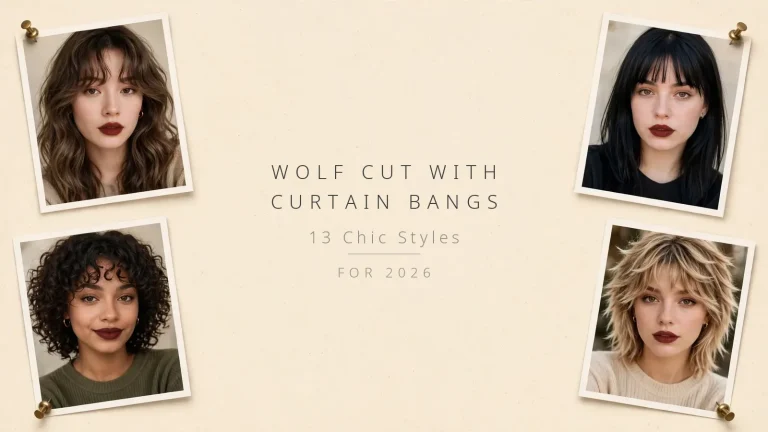
- 3. Wavy Wolf Cut With Curtain Bangs
- 4. Airy Bangs for Fine Wavy Hair
- 5. Bold Highlights on Textured Waves
- 6. Wavy Wolf Cut With Bangs for Curly Hair
- 7. Face-Framing Layers and Wispy Bangs
- 8. Effortless Everyday Wavy Wolf Cut
- 9. Medium-Length Wolf Cut With Maximum Movement
- 10. Retro Waves With a Modern Fringe
- 11. Rich Brunette Wavy Wolf Cut
- 12. Sun-Kissed Blonde Wavy Wolf Cut
- 13. Side-Swept Bangs on Loose Waves
- 14. Bohemian Free-Spirit Waves
- 15. Glossy Dark Wavy Wolf Cut
- 16. Wavy Wolf Cut With Bangs for Thick Hair
- How to Choose the Right Wavy Wolf Cut With Bangs
- How to Style a Wavy Wolf Cut With Bangs
- Wavy Wolf Cut With Bangs Maintenance and Upkeep
- Common Mistakes to Avoid
- How to Transition Into a Wavy Wolf Cut With Bangs
- Wolf Cut vs Butterfly Cut: Which Is Better?
- Celebrity Inspiration
- FAQs
- Which is better, a butterfly cut or a wolf cut?
- Can I get a wolf cut with no bangs?
- Can an older woman wear a wolf cut?
- Who should not get a wolf cut?
- How often should I trim a wavy wolf cut with bangs?
- What products work best for this style?
- Does this cut work on straight hair?
- How do I ask my stylist for it?
16 Wavy Wolf Cut With Bangs Ideas Worth Trying
Quick comparison – find your match before scrolling the full gallery:
| Style | Length | Fringe type | Best hair characteristics | Maintenance |
|---|---|---|---|---|
| Long Wavy Wolf Cut With Bangs | Long | Light straight-across | Thick to medium-density wavy hair | Low-medium |
| Short Choppy Wolf Cut With Soft Bangs | Short | Soft wispy | Fine to medium hair needing lift | Low |
| Wavy Wolf Cut With Curtain Bangs | Medium-long | Curtain | All densities; suits glasses wearers | Low |
| Airy Bangs for Fine Wavy Hair | Short-medium | Airy wispy | Fine, low-density hair | Low |
| Bold Highlights on Textured Waves | Medium-long | Any | Medium to thick, color-treated hair | Medium (color upkeep) |
| Wavy Wolf Cut With Bangs for Curly Hair | Medium-long | Curly fringe | 2C-3B curls, medium to thick density | Medium |
| Face-Framing Layers and Wispy Bangs | Medium | Wispy | Medium-density hair | Low-medium |
| Effortless Everyday Wavy Wolf Cut | Medium | Piecey | Medium density; busy routines | Very low |
| Medium-Length Wolf Cut With Maximum Movement | Medium | Soft straight | Fine to thick; safest first wolf cut | Low |
| Retro Waves With a Modern Fringe | Medium-long | Full retro | Thick, high-density hair | Medium |
| Rich Brunette Wavy Wolf Cut | Any | Any | Natural brunettes, medium to thick | Low |
| Sun-Kissed Blonde Wavy Wolf Cut | Medium-long | Any | Fine to medium, color-treated hair | High (toning) |
| Side-Swept Bangs on Loose Waves | Medium-long | Side-swept | All densities; hides cowlicks | Low |
| Bohemian Free-Spirit Waves | Long | Piecey | Medium to thick, naturally wavy | Very low |
| Glossy Dark Wavy Wolf Cut | Medium-long | Sleek straight | Naturally dark, thick hair | Low-medium |
| Wavy Wolf Cut With Bangs for Thick Hair | Any | Any | Very thick, dense or coarse hair | Medium |
1. Long Wavy Wolf Cut With Bangs

Long hair keeps all the drama, but long layers cut in a wolf pattern stop it from hanging flat. The fringe sits light on the forehead while the lengths move freely, which is why this version photographs so well. It is also the closest match to long wolf cuts with curtain bangs if you want to compare lengths before booking.
Benefits:
- Keeps your length while removing the heavy, dragging ends
- Creates movement through the mid-lengths without thinning the bottom
- Versatile for updos, braids, and half-up styles
Pro Tip: Ask your stylist to point-cut the ends rather than blunt-cutting them for softer, more blended layers.
How To Style: Apply a lightweight wave spray to damp hair, then twist sections around your fingers and air-dry for natural-looking movement.
Best For: Thick to medium-density hair with natural wave, oval and oblong face shapes.
2. Short Choppy Wolf Cut With Soft Bangs

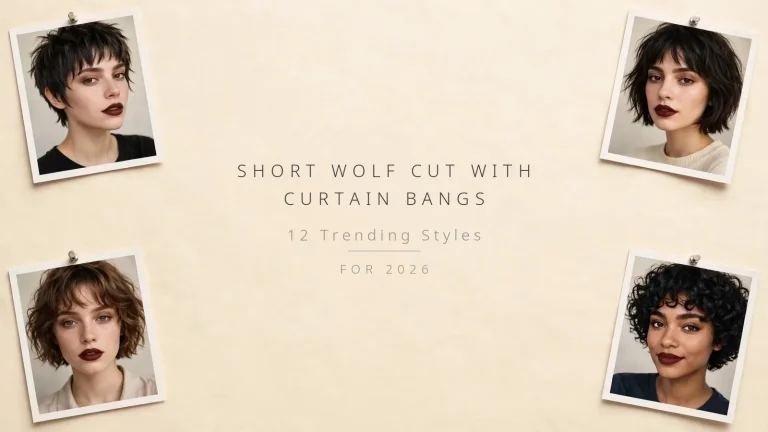
A shorter take on the wavy wolf cut with bangs trades length for texture. Choppy ends around the jaw and cheekbones give fine hair instant body, and the soft fringe keeps the whole thing from reading too severe. This is the version to pick when you want a real change, not a trim. If you want to go even shorter, the short wolf cut with curtain bangs keeps the same choppy texture at jaw length.
Benefits:
- Wash-and-go texture with almost no heat styling needed
- Builds volume at the crown where short hair often goes flat
- Grows out into a shaggy bob instead of an awkward stage
Pro Tip: Rub a pea-sized amount of texture paste between your palms and pinch the dry ends — never rake it through, or you will flatten the choppiness.
How To Style: Mist damp hair with sea salt spray, scrunch upward with your hands, and let it air-dry.
Best For: Fine to medium-density hair that needs lift; round and heart-shaped faces.
3. Wavy Wolf Cut With Curtain Bangs

When the fringe parts softly in the middle, you get the curtain effect that flatters almost everyone. The parted bangs blend straight into the face-framing layers, so there is no harsh line across the forehead. For more fringe-focused takes, browse the classic wolf cut with curtain bangs gallery.
Benefits:
- Grows out gracefully with no blunt regrowth line
- Softens a wide forehead without hiding your face
- Sits well with glasses since the part keeps hair off the frames
Pro Tip: Blow-dry the bangs forward first, then sweep each side outward with a round brush for that curved curtain shape.
How To Style: Place two large Velcro rollers on the damp fringe, one per side, and leave them in while you finish your makeup.
Best For: All hair densities; especially long and oval faces that want width at the cheeks.
4. Airy Bangs for Fine Wavy Hair
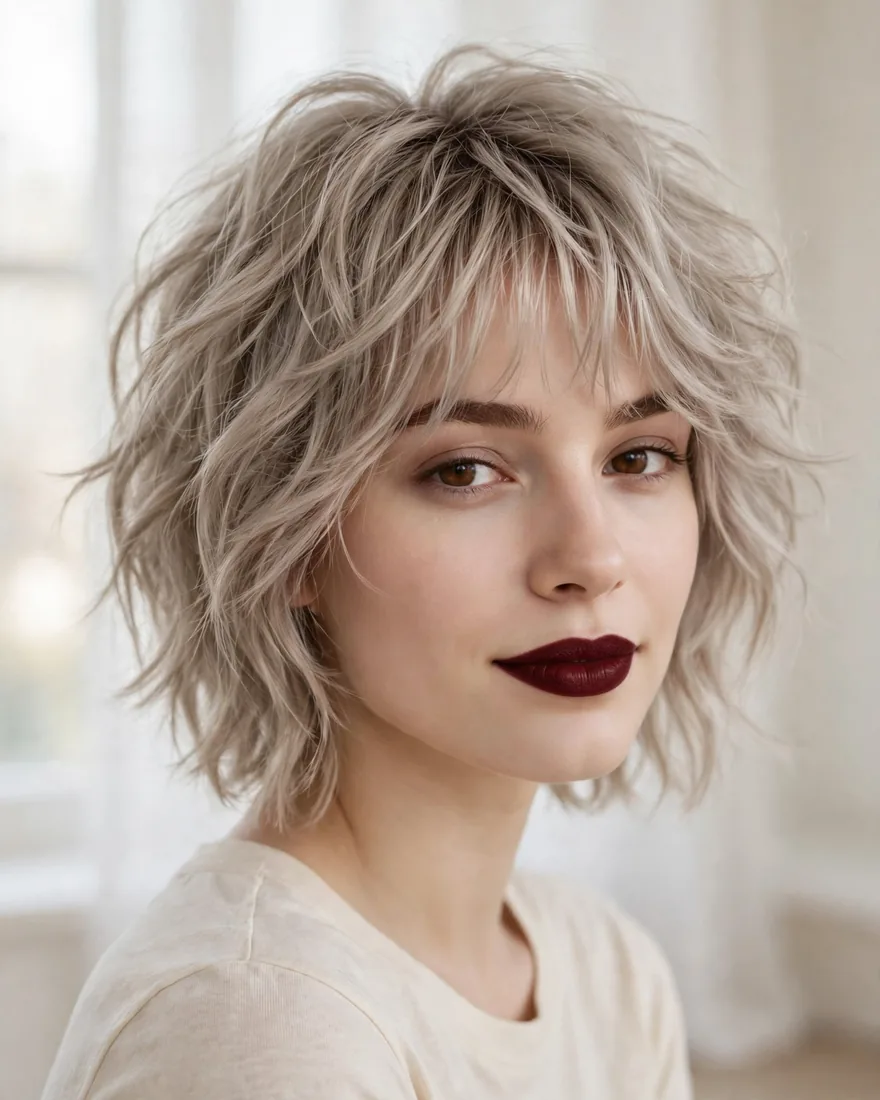
Fine hair and wolf cuts are a better match than most people expect. Short, airy layers through the crown create the illusion of density, while a wispy fringe adds interest without eating up precious hair. The trick is keeping the layers shallow so the ends do not turn see-through.
Benefits:
- Fabricates volume at the roots where fine hair needs it most
- Light ends swing freely instead of clinging to the neck
- A wispy fringe uses very little hair, so density stays put
Pro Tip: Skip heavy layering on fine hair — ask for long, soft layers only through the top half, or a wavy wolf cut with bangs can turn stringy at the bottom.
How To Style: Work volumizing mousse into the roots, flip your head upside down, and rough-dry until just damp.
Best For: Fine, low-density hair; oval and round faces.
5. Bold Highlights on Textured Waves
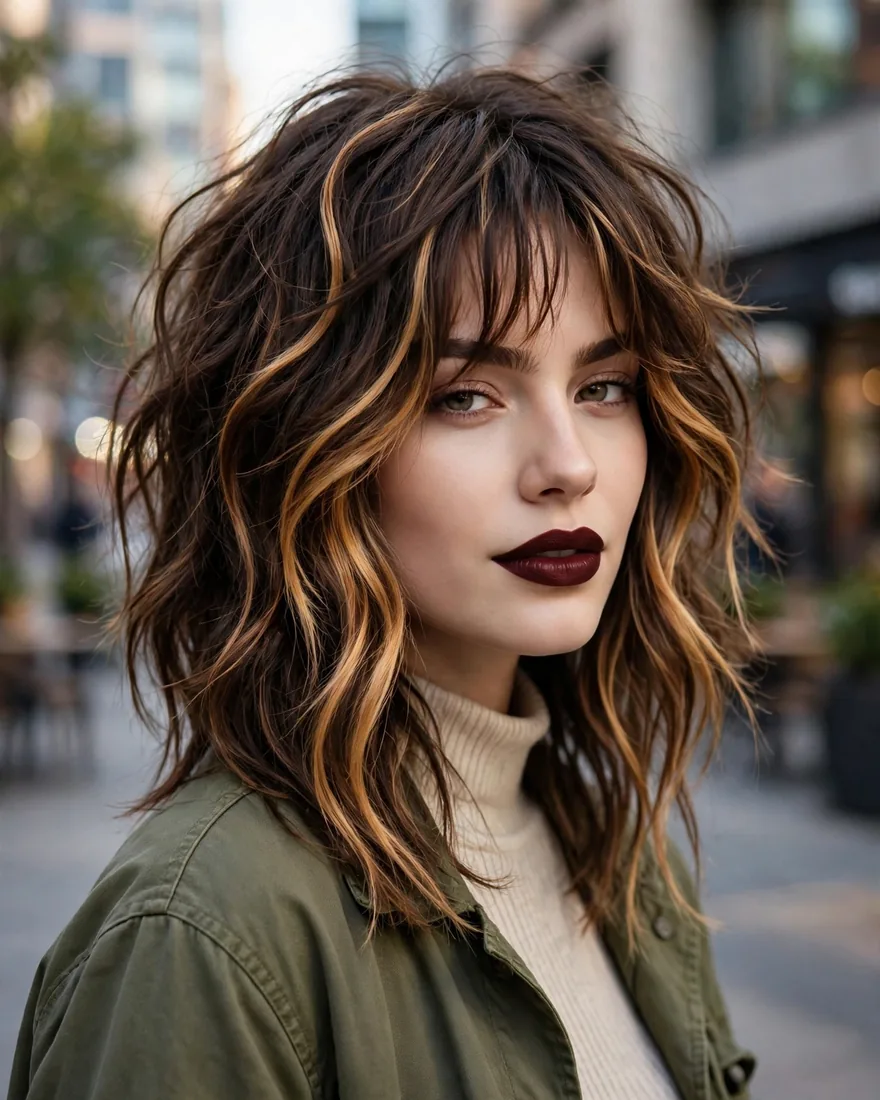
Color does half the styling work on a wavy wolf cut with bangs. Bold, face-framing highlights trace each layer, so the texture reads even on days you do nothing to it. Keep the brightest pieces around the fringe and cheekbones where the eye lands first.
Benefits:
- Highlights map the layers, making texture visible from across the room
- Bright pieces near the face lift the complexion
- Regrowth looks intentional rather than neglected
Pro Tip: Ask for hand-painted balayage instead of foils — the softer grow-out suits the undone nature of this cut. Protect the color with sulfate-free shampoo and a gloss refresh every 6–8 weeks, since highlighted ends fade fastest.
How To Style: Scrunch a curl-defining cream through damp waves to separate the highlighted pieces.
Best For: Medium to thick hair, warm and neutral skin tones.
6. Wavy Wolf Cut With Bangs for Curly Hair

True curls love the wolf cut because the layered shape fights the dreaded triangle effect. Weight comes off the ends, so curls spring up instead of being dragged down. If your pattern is tighter than a loose wave, the dedicated curly wolf cut guide covers curl-by-curl cutting in more depth.
Benefits:
- Removes bulk from the ends so curls keep their spring
- Layers fall at different lengths, which stops the pyramid silhouette
- A curly fringe blends in instead of sitting apart like a straight one would
Pro Tip: Get it cut dry, curl by curl. Wet cutting on curly hair always springs shorter than expected.
How To Style: Apply curl cream to soaking-wet hair, then diffuse on low heat, lifting sections at the root.
Best For: Medium to thick density, 2C to 3B curl patterns; all face shapes.
7. Face-Framing Layers and Wispy Bangs

This version puts the shortest layers right where they matter: around the face. Pieces that start at the cheekbones draw attention to the eyes and cheekbones, while the wispy fringe keeps the forehead light. It is contouring, but with scissors. Still deciding on a fringe shape? The types of bangs guide compares every option side by side.
Benefits:
- Shorter front pieces spotlight the cheekbones and eyes
- Softens a strong jawline without hiding it completely
- Looks polished in photos from every angle
Pro Tip: Keep the shortest face-framing piece no higher than the chin — go shorter and the layers flip outward uncontrollably.
How To Style: Bend the front sections around a flat iron, turning the wrist outward at the ends for a soft flick.
Best For: Square and round faces, medium-density hair.
8. Effortless Everyday Wavy Wolf Cut

Not every wavy wolf cut with bangs needs to make a statement. This toned-down version keeps the layers longer and the fringe piecey, so it reads as great hair rather than a bold haircut. It is the one office workers and busy parents actually stick with.
Benefits:
- A quick morning routine – around five minutes for most wavy textures – heat tools optional
- Second-day hair looks better than wash day, not worse
- Conservative enough for strict workplaces, textured enough to feel current
Pro Tip: Sleep on a silk pillowcase. It preserves the wave pattern overnight, which is the whole secret behind the low effort.
How To Style: Braid damp hair into two loose braids before bed, undo in the morning, and shake out the roots.
Best For: Busy routines, medium-density hair, anyone new to short fringe.
9. Medium-Length Wolf Cut With Maximum Movement

Medium length is the sweet spot: long enough to tie back, short enough to hold volume. The wolf layers do their best work here because there is enough hair to show the texture but not so much that it collapses. Most first-timers land here and stay here.
Benefits:
- Holds volume better than long hair, offers more styling options than short
- Trims are quick and cheap since less hair needs reshaping
- Sits above jacket collars and scarves without bunching
Pro Tip: Ask for the shortest layer to start at the cheekbone — higher kills the swing, lower kills the volume.
How To Style: Rough-dry with your fingers, then smooth just the fringe with a small round brush.
Best For: Fine to thick densities, all face shapes — the safest first wolf cut.
10. Retro Waves With a Modern Fringe
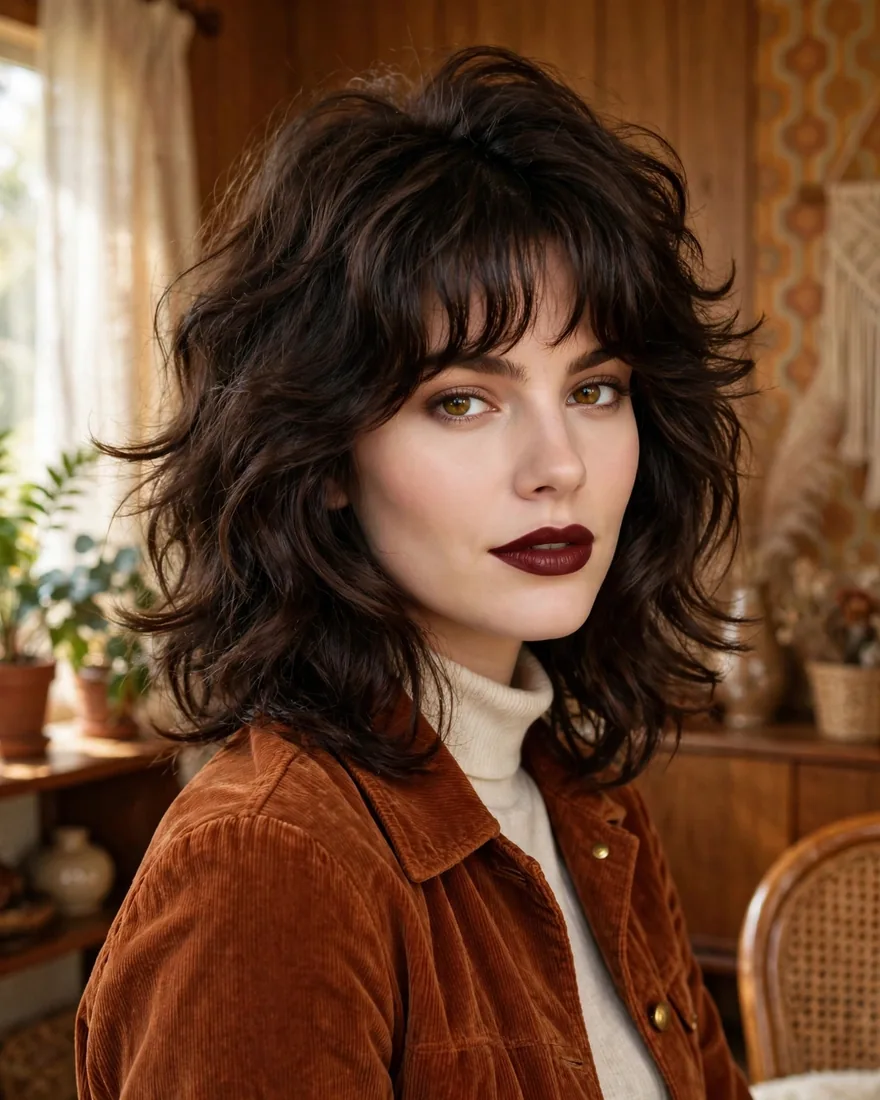
The wolf cut was born from 1970s shag, and this version leans into those roots. Extra volume at the crown, flicked ends, and a full fringe give real vintage energy — but the modern cutting technique keeps it wearable instead of costume-like.
Benefits:
- Maximum crown volume for hair that usually lies flat
- Flicked ends create a fun, bouncy silhouette in motion
- Stands out in a sea of identical long layers
Pro Tip: Keep the fringe piece slightly longer than classic 70s cuts — modern foreheads and modern offices prefer it.
How To Style: Set the top sections on large hot rollers for twenty minutes to build that retro lift into a wavy wolf cut with bangs.
Best For: Thick, high-density hair that can support the volume; oval and long faces.
11. Rich Brunette Wavy Wolf Cut

Brown hair shows off layered texture beautifully – the eye reads the depth between the natural shades. A rich, natural brunette makes every wave in the cut visible without any bleach damage. Fans of dimensional brunettes should also look at the California brunette color guide for tone ideas.
Benefits:
- Natural depth makes layers look thicker than they are
- Zero bleach means the hair stays healthy and shiny
- Regrowth is invisible, so salon visits stretch further apart
Pro Tip: A clear gloss treatment every two months keeps brown tones reflective — dull brown flattens the whole cut.
How To Style: Finish with a pea-sized drop of shine serum, smoothed only over the mid-lengths and ends.
Best For: Natural brunettes, medium to thick hair.
12. Sun-Kissed Blonde Wavy Wolf Cut

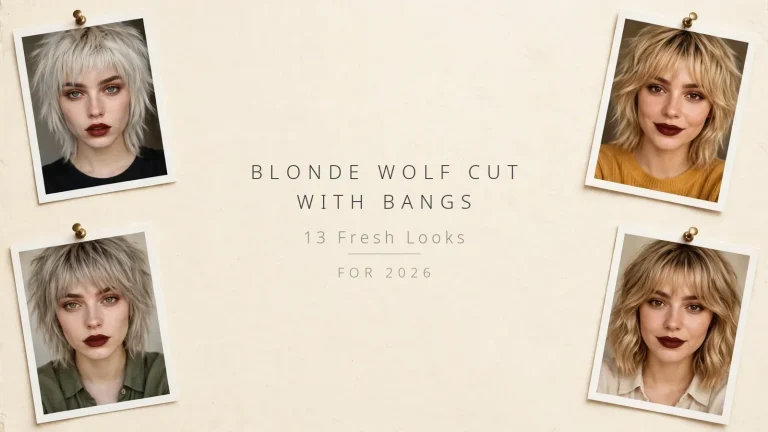
Lighter blonde shades turn every wave into a highlight of its own. The brightness opens up the face, and the textured ends keep blonde from looking flat or wig-like. If you are going fully light, the blonde wolf cut with bangs collection has more shade variations to compare.
Benefits:
- Light tones make texture readable even in dim indoor light
- Brightens the complexion and softens strong features
- Sun-kissed regrowth looks deliberate, not overdue
Pro Tip: Wash with purple shampoo once a week — blonde wolf layers turn brassy fast because the thinned ends grab minerals.
How To Style: Always use a heat protectant before any hot tool; bleached ends snap easily under high heat.
Best For: Fine to medium-density hair; fair to medium skin tones.
13. Side-Swept Bangs on Loose Waves

Sweeping the fringe to one side breaks the symmetry and adds instant diagonal interest. This is the most forgiving fringe option because it hides cowlicks and uneven growth instead of fighting them. It also restyles into a center part in seconds.
Benefits:
- Covers a high forehead without a heavy straight-across line
- Diagonal lines slim a round face visually
- Hides cowlicks and awkward growth patterns at the hairline
Pro Tip: Sweep the fringe while it is still damp and let it dry in position — dry restyling never holds as well.
How To Style: Create a deep side part, sweep the fringe across, and tuck the lighter side behind one ear.
Best For: All hair densities; round and square faces, anyone with a stubborn cowlick.
14. Bohemian Free-Spirit Waves

The bohemian take keeps everything long, loose, and a little undone. Layers are soft rather than choppy, the fringe is piecey, and the whole cut is designed to look better slightly messy. It is the festival-headliner version of the wolf cut.
Benefits:
- Lived-in texture means bedhead actually works as a style
- Forgiving grow-out — months pass before it needs reshaping
- Pairs naturally with braids, scarves, and hair accessories
Pro Tip: Skip the round brush entirely for this one — finger-drying preserves the imperfect texture that makes it work.
How To Style: Mist with texture spray, braid into three loose braids overnight, and separate the waves in the morning.
Best For: Medium to thick density, naturally wavy textures; creative dressers.
15. Glossy Dark Wavy Wolf Cut

Dark shades give the wavy wolf cut with bangs a completely different mood — sleek, dramatic, and high-shine. Deep color reflects light off every layer, so the cut looks expensive even with minimal styling. This is the version for anyone who wants edge without bleach.
Benefits:
- Dark color reflects light, making hair look healthier and thicker
- High contrast between the layers reads as intentional and sharp
- No lightening means zero bleach damage to the delicate ends
Pro Tip: Use a color-safe, sulfate-free shampoo — dark dye fades fastest on the thinned, porous ends of layered cuts.
How To Style: Blow-dry smooth with a paddle brush, then add loose bends with a large-barrel iron for glossy waves.
Best For: Naturally dark, thick hair; anyone avoiding bleach.
16. Wavy Wolf Cut With Bangs for Thick Hair

Thick hair is where the wolf cut earns its reputation. Strategic internal layers remove serious bulk without touching the length, so dense hair finally moves. For even more texture-forward takes on heavy hair, see the shaggy wolf cut with bangs ideas.
Benefits:
- Removes weight from the inside, so the outside keeps its length
- Stops the bottom-heavy triangle shape thick hair tends toward
- Drying time drops noticeably with less bulk to dry
Pro Tip: Ask for thinning shears used sparingly on the interior only — over-thinning the ends makes thick hair frizzy, not light.
How To Style: Dry in sections, lifting each layer at the root with a round brush so the weight distributes evenly.
Best For: Very thick, dense, or coarse hair that overwhelms blunt cuts.
How to Choose the Right Wavy Wolf Cut With Bangs
Start with your face shape, because it decides where the shortest layers should land. Oval faces can take almost any version. Round faces do best with height at the crown and longer front pieces that slim the cheeks. Long faces need width, so curtain or side-swept bangs work better than a short straight fringe. Square faces soften with wispy, textured edges around the jaw.
Next, be honest about your hair density. Fine hair needs shallow, careful layering or the ends go see-through. Thick hair needs aggressive interior thinning or the cut turns into a triangle. Your natural texture matters too — true waves need the least daily work, while straight hair will need heat or overnight styling to hold the shape. And if you are torn between edgy texture and clean polish, ask your stylist to show you the cut both ways at your appointment — the same layers behave completely differently with a smooth blowout.
Finally, consider the fringe commitment. Bangs need trimming every three to four weeks and look best styled damp each morning. If that sounds like too much, choose a longer curtain fringe that grows out gracefully. Bring three reference photos to your appointment — one you love, one showing the length, one showing the fringe — and your stylist can map the cut to your hair instead of guessing.
Bang Types and Face Shapes
Not every fringe suits every face — match the bang type to your face shape before you commit to a wavy wolf cut with bangs.
| Bang type | Best face shapes | Why it works |
|---|---|---|
| Curtain bangs | Round, oval, heart | Parts in the middle and melts into the layers, softening a strong jaw and adding width at the cheeks |
| Blunt / straight-across | Oval, long | Adds horizontal width that visually shortens a long face |
| Side-swept | Round, square | The diagonal line slims full cheeks and hides cowlicks at the hairline |
| Wispy / piecey | All — ideal for fine hair | Uses very little hair, so the crown keeps its fullness |
| Bottleneck | Oval, heart | Narrow at the top, wider at the cheekbones — balances a wider forehead |
| Micro bangs | Oval, petite features | Bold and editorial; needs trims every 2–3 weeks to hold the line |
What to Tell Your Stylist
Salon language gets you closer to the reference photo on the first visit. Ask for internal layers to remove weight without losing length, point-cutting on the ends for softness instead of a blunt line, and layers cut dry if your waves shrink up when wet. Mention the triangle effect — you want to avoid it, not create it — and book dusting trims for the fringe between full appointments.
Pros and Cons
Pros: genuinely low-effort daily styling on wavy hair; endlessly customizable by length, fringe, and color; grows out gracefully into a shag.
Cons: needs reshaping every 6–8 weeks; bangs demand frequent trims; not the cut for anyone who wants a polished, classic look.
How to Style a Wavy Wolf Cut With Bangs
Styling a wavy wolf cut with bangs is easier than it looks because the cut does most of the work. What actually matters is your routine around three moments: wash day, daily styling, and second-day refresh.
Every routine starts the same way: damp hair, and products in this order — heat protectant first if you use hot tools, then mousse or curl cream for hold, then a salt spray for texture.
Quick version: air-drying gives the most natural finish – scrunch product into damp hair and leave it alone. diffusing on low heat adds root volume when you are short on time. second-day hair usually needs only dry shampoo at the rrootsaroots and water mist on the ends. the three routines below cover each method in detail.
Wash-Day Routine
Shampoo the roots only and condition the mid-lengths and ends. Never pile all your hair on top of your head — that tangles layered cuts badly. Out of the shower, squeeze (never rub) with a microfiber towel, then apply your products to damp hair.
Daily Styling Methods
You have three reliable methods. Air-drying with scrunched-in product gives the most natural result. Diffusing on low heat while lifting at the roots gives more volume in less time. A large-barrel curling iron, used on just the top layer, refreshes second-day hair in under ten minutes. Style the fringe separately and always first — it dries fastest and sets the tone for the whole cut. For extra definition, try plopping: wrap damp, product-loaded hair in a microfiber towel for 20 minutes before diffusing. Smooth curl cream down the lengths with the prayer-hands method to keep wave clumps intact, and flip your head upside down while diffusing for root lift that lasts all day.
Second-Day Refresh
Second-day hair is where this cut shines. Spritz the roots with dry shampoo, revive the ends with a light mist of water mixed with leave-in conditioner, and reshape the fringe with a quick pass of a mini straightener. Keep a small round brush by your mirror for fringe touch-ups; thirty seconds there matters more than ten minutes on the lengths.
Wavy Wolf Cut With Bangs Maintenance and Upkeep
Mark your calendar: full reshaping every six to eight weeks keeps the layers of a wavy wolf cut with bangs from collapsing into one length — put a recurring reminder in your phone so it never slips past ten weeks. The fringe needs attention sooner, a quick trim every three to four weeks, which many salons do free or cheap between full appointments; learning to dust your own bang tips with sharp scissors saves both time and money.
Between appointments, protect the thinned ends: they are the oldest, most fragile part of the cut, so weekly deep conditioning and minimal heat go a long way. Sleep on silk or satin, never brush it dry — detangle only when damp with conditioner in it, working from the ends upward. Growing it out is surprisingly painless too: let the fringe grow into curtain bangs, keep the crown trimmed lightly, and the cut melts into a long shag over three to four months. If you color, schedule gloss or toner refreshes halfway between cuts to keep the layers looking intentional.
Trim Schedule by Bang Type
| What needs trimming | Every | Notes |
|---|---|---|
| Full reshape | 6–8 weeks | Keeps the layers from collapsing into one length |
| Curtain bangs | 6–10 weeks | The most forgiving fringe; grows out softly |
| Blunt bangs | 4–6 weeks | Loses its sharp line fast — book ahead |
| Wispy fringe | About 3 weeks | A quick dusting keeps it off your eyes |
The upside: a wavy wolf cut with bangs grows out gracefully — the layers melt into a long shag over three to four months, so a missed appointment never looks disastrous.
Common Mistakes to Avoid
Most disappointing wavy wolf cut with bangs outcomes come from the same few errors. Too much volume at the crown is the biggest one — keep the top layers light and texturized, or the cut reads dated instead of edgy. Overly structured, helmet-straight bangs fight the whole idea of the cut; the fringe should look soft and piecey, never ironed flat. And go easy on heavy creams and oils — they drag the layers down and kill the airy shape this cut is built on.
- Skipping the fringe trim — grown-out bangs drag the whole cut down with them
- Thinning the ends instead of the interior — frizzy ends, flat crown
- Blow-drying everything smooth — you paid for texture, let it show
How to Transition Into a Wavy Wolf Cut With Bangs
You do not have to go full shag on day one. Start with longer, softer layers and a curtain fringe that grows out gracefully — you get the shape without the commitment. Live with it for one full trim cycle (6–8 weeks), then go shorter and choppier at the next appointment if you love it.
This gradual path also suits cautious workplaces and anyone growing out a blunt cut: each appointment removes a little more weight and adds a little more texture, so the change never shocks anyone — including you.
Wolf Cut vs Butterfly Cut: Which Is Better?
The butterfly cut is the wolf cut’s polished cousin: long, bouncy, face-framing layers with plenty of movement but no choppiness and no mullet DNA. Choose the wavy wolf cut with bangs if you want edge, texture, and undone volume; choose the butterfly if you want glamour, smoothness, and a blowout look.
On wavy hair, a wavy wolf cut with bangs needs less daily effort — the texture does the work. The butterfly demands more blow-drying to look right. If you cannot decide, start butterfly: a stylist can texturize it into a wolf cut later, but going the other way means growing length back.
Celebrity Inspiration
Need a reference photo for your wavy wolf cut with bangs? Billie Eilish’s choppy wolf cut made the style mainstream, Miley Cyrus wore the full mullet-shag version, and Zendaya has shown how curtain bangs soften the whole look. Save the one closest to your natural hair texture — your stylist will thank you.
FAQs
Which is better, a butterfly cut or a wolf cut?
Neither is objectively better — it depends on the finish you want. The wolf cut is edgy, choppy, and undone with real texture; the butterfly cut is polished, bouncy, and blowout-smooth. On wavy hair, the wolf cut with bangs needs less daily styling, while the butterfly needs more blow-drying to look right.
Can I get a wolf cut with no bangs?
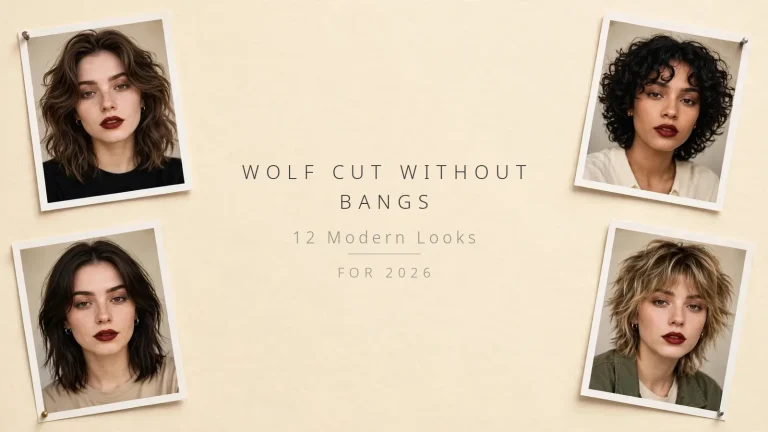
Yes. Ask for the shortest face-framing layers to start at the cheekbone instead of a fringe — you keep the shaggy shape of the wolf cut with a grown-out, low-commitment front.
Can an older woman wear a wolf cut?
Absolutely. Softer, longer layers — a silver or salt-and-pepper wolf bob, for example — look modern at any age, because the cut is about texture, not youth. Keep the fringe wispy rather than heavy.
Who should not get a wolf cut?
Anyone who wants a sleek, polished, corporate look will fight this cut every morning. Very fine, sparse hair can also struggle, since the layers need some density to avoid stringy ends — and if you hate styling a fringe, skip the bangs.
How often should I trim a wavy wolf cut with bangs?
Every six to eight weeks keeps the shape of a wavy wolf cut with bangs intact. The fringe needs quicker attention — a light dusting every three to four weeks stops it from falling into your eyes.
What products work best for this style?
Lightweight mousse, sea salt spray, curl cream, and a root-lifting powder cover nearly every need. Skip heavy oils and thick butters — they drag the layers down and kill the airy shape.
Does this cut work on straight hair?
Yes, but expect more daily styling effort. A curling wand or heatless overnight braids create the waves, and a salt spray helps straight hair hold the texture through the day.
How do I ask my stylist for it?
Bring three photos: one showing the overall vibe, one showing your preferred length, and one showing the exact fringe. Ask for shaggy internal layers with a soft fringe, and mention your natural texture so the cut is designed around it.
Conclusion
The wavy wolf cut with bangs works because it cooperates with texture instead of fighting it. Pick the length and fringe that match your face shape and routine, keep up with trims, and let the layers do most of the styling for you.
Start with the version closest to your natural hair, take reference photos to your appointment, and give your wavy wolf cut with bangs two weeks to settle before judging it. Fresh layers always sit a little differently after the first wash. Good hair days get a lot easier from there.