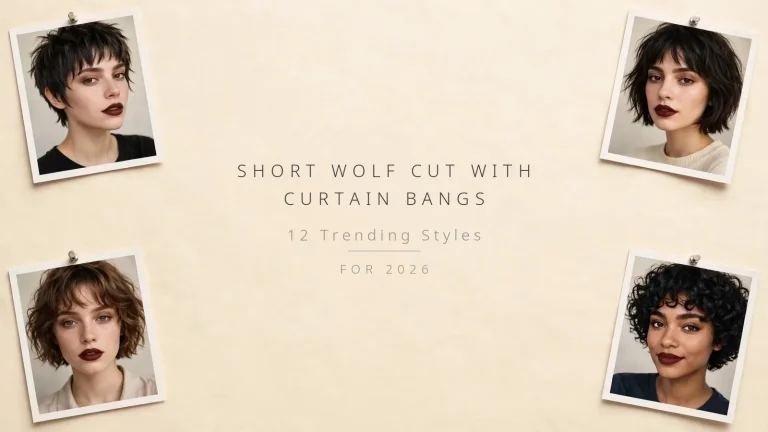

Wolf Cut with Curtain Bangs – 13 Chic Styles for 2026
Curtain bangs promise effortless romance, but real mornings tell a different story: the center part flattens overnight into a limp triangle, one side curls under your pillow crease, and a blow-dryer suddenly feels like a second job. Then there is the whispered regret scenario — asking for curtain bangs and walking out with them cut two inches too short and blunt, which no parting trick can rescue.
Here is the good news: a wolf cut with curtain bangs is one of the most forgiving ways to wear them. The wolf cut’s built-in layering and crown volume give the drape something to blend into, so the bangs look intentional even on rushed mornings. Below are 13 genuinely different styles — wash-and-go to polished — with honest notes on who each flatters, the daily effort involved, and exactly what to tell your stylist.
Table of Contents
- 13 Wolf Cut with Curtain Bangs Ideas
- 1. Classic Shoulder-Length Wolf Cut with Curtain Bangs
- 2. Long Airy Center-Split Wolf Cut with Curtain Bangs
- 3. Short Crop Wolf Cut with Bold Curtain Bangs
- 4. Soft Wispy Entry Wolf Cut with Curtain Bangs
- 5. Choppy Maximum-Texture Wolf Cut with Curtain Bangs
- 6. Wavy Self-Styling Wolf Cut with Curtain Bangs
- 7. Sleek Straight Wolf Cut with Curtain Bangs
- 8. Curly Curl-Preserving Wolf Cut with Curtain Bangs
- 9. Colored Face-Framing Wolf Cut with Curtain Bangs
- 10. Deep Side-Part Wolf Cut with Curtain Bangs
- 11. Feathered 70s Wolf Cut with Curtain Bangs
- 12. Fine-Hair Volume Wolf Cut with Curtain Bangs
- 13. Thick-Hair Movement Wolf Cut with Curtain Bangs
- How to Choose the Right Wolf Cut with Curtain Bangs for Your Face Shape
- Common Mistakes to Avoid with Curtain Bangs
- FAQs
- How long does this haircut take to style every morning?
- How much does this cut cost, including upkeep?
- Will curtain bangs work if my forehead is small?
- Can I pull this haircut into a ponytail or gym bun?
- How often do curtain bangs need a trim?
- What should I ask for at the salon so the bangs don’t come out too short?
- Do curtain bangs work on curly hair?
- How do I fix bedhead curtain bangs without washing my hair?
13 Wolf Cut with Curtain Bangs Ideas
1. Classic Shoulder-Length Wolf Cut with Curtain Bangs

The reference version everything else builds on: shoulder length, fringe split down the center and draping along the cheekbones. Layers fall from a fuller crown into thinner ends, and the bangs melt into the face-framing layers with no visible line. It photographs well from every angle.
- Benefits: The center-parted drape narrows wider foreheads and softens a strong jawline; shoulder length keeps styling short; the shape grows out gracefully, so a missed trim is no disaster.
- Pro Tip: Ask for the bangs cut at least one inch longer than you think — they spring up shorter once styled, and wet hair lies longer than dry.
- How To Style: Blow-dry the bangs forward and down first (against the cowlick), then round-brush them back and outward from the center part so they curve around the face. Finish with a quick tousle of texturizing spray.
- Best For: Oval and heart faces; medium-density straight to wavy hair. If your hair is extremely fine, this version can fall flat by midday without volumizing product at the roots.
2. Long Airy Center-Split Wolf Cut with Curtain Bangs

Want this cut without giving up length? This version keeps everything past the collarbone with long, airy layers, and the bangs stay slightly longer, grazing the cheekbones. The weight of long hair pulls the drape down, making it one of the easiest versions to manage.
- Benefits: Length makes the bangs behave with less effort; the longer drape suits smaller foreheads; it doubles as a grown-out version if you already have this haircut.
- Pro Tip: Long bangs go stringy fast without conditioner — keep the fringe hydrated or it separates into thin ropes instead of draping as a sheet.
- How To Style: Rough-dry until nearly dry, then wrap the bangs around a large round brush pointing away from the face and hit with cool air. A pea of smoothing cream through the lengths prevents frizz.
- Best For: Round and square faces (the long vertical lines are slimming); medium to thick hair. For extra length inspiration, see our long wolf cuts with curtain bangs roundup.
3. Short Crop Wolf Cut with Bold Curtain Bangs

The boldest take: cropped, with fuller, shorter, deliberately statement-making bangs sitting higher on the forehead and a crisp center part. The look reads modern and edgy rather than soft — and less hair means faster drying that benefits from a little messiness.
- Benefits: Fastest styling here — most people finish in under ten minutes; the bold bangs strengthen fine features; it is the most fashion-forward option and grows out into the classic version.
- Pro Tip: On short bangs, matte paste beats cream — creams make them separate and cling, while paste keeps them piecey without shine overload.
- How To Style: Scrunch damp hair with a light mousse, diffuse or air-dry, then pinch the bangs into place with a tiny bit of paste. Don’t over-brush — the texture is the point.
- Best For: Oval and long faces (shorter bangs visually shorten the face); fine to medium hair. See more cropped takes in our short wolf cut with curtain bangs guide.
4. Soft Wispy Entry Wolf Cut with Curtain Bangs

The entry version for the nervous: bangs cut wispy and feather-light, so the fringe barely registers. The wisps are longer, thinner, and highly forgiving — hate them and they pin back invisibly; love them and they grow into a fuller version within a month.
- Benefits: The lowest-commitment bangs — easy to hide, fast to grow out; the wispy texture never looks heavy; it suits hair that grows straight down and resists a part.
- Pro Tip: Wispy bangs show oil first — keep dry shampoo at your desk; a thirty-second refresh at lunch keeps them fresh all day.
- How To Style: Finger-dry the bangs while pushing them apart at the center, then twist each side once around your finger to set the parting. Leave the rest alone — air-drying suits this one.
- Best For: Anyone trying bangs for the first time; diamond and oblong faces; fine hair that gets overwhelmed by heavy fringe.
5. Choppy Maximum-Texture Wolf Cut with Curtain Bangs
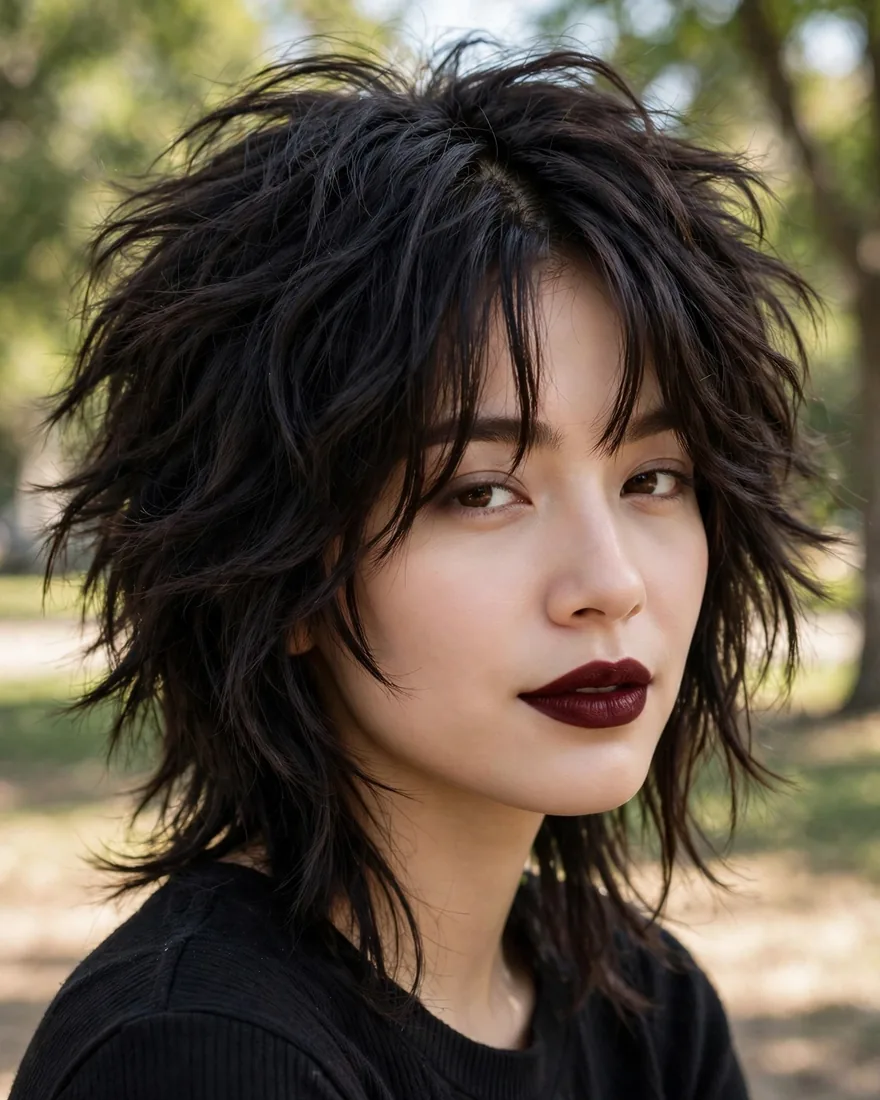
The smooth drape with the volume turned up: heavy point-cutting gives every layer a jagged, piecey edge, and the bangs are textured rather than blunt — they move, separate, and look lived-in instead of helmet-like. The version that looks like you woke up cool on purpose.
- Benefits: Texture hides regrowth and imperfect trims best; the choppy bangs disguise a cowlick or widow’s peak; it reads deliberately styled even when you did almost nothing.
- Pro Tip: Heavy texture is a one-way door — start with less and ask your stylist to add more after you live with it for a week.
- How To Style: Work sea-salt or texture spray through damp hair, scrunch, and air-dry or diffuse on low. Once dry, rake a pea of clay through the bangs to separate them into pieces.
- Best For: Thick hair that needs weight removed; square and angular faces (the jaggedness breaks up hard lines); anyone who dislikes polished, “done” hair.
6. Wavy Self-Styling Wolf Cut with Curtain Bangs

The lazy-day champion: the natural wave pattern does the styling work. Layers are cut to let waves clump and bounce, and the bangs follow the same wave, so the drape forms itself with minimal heat. On air-dry days, it asks nothing more than a scrunch.
- Benefits: Nearly zero-heat styling — waves hold the part and drape on their own; the texture gives fine hair the illusion of density; second-day hair often looks better than freshly washed.
- Pro Tip: Sleep with the bangs loosely clipped up in a center part (a soft claw clip works) so the drape survives the night.
- How To Style: Scrunch wave-enhancing cream into damp hair, part the bangs down the center with your fingers, and air-dry. Once dry, shake the crown roots to keep the volume.
- Best For: Natural 2A–2C waves; medium-density hair; anyone who wants a wavy wolf cut with bangs aesthetic with the face-framing drape of curtains.
7. Sleek Straight Wolf Cut with Curtain Bangs

The polished outlier: worn sleek and straight, the fringe flat-ironed into a glassy center-parted curtain, with the wolf cut’s layers still giving it movement. It reads editorial rather than boho — think runway version. The honest trade-off is effort: straight hair shows every uneven inch, so this needs the most daily attention.
- Benefits: The most versatile for professional settings; the sleek curtain emphasizes the face-framing effect; it photographs with incredible shine.
- Pro Tip: Flat-iron the bangs last — reheating them multiple times fries the most visible section first.
- How To Style: Blow-dry smooth with a paddle brush, then flat-iron the bangs in an outward C-curve to set the drape. A light shine serum (not oil) on the mid-lengths keeps it glassy.
- Best For: Naturally straight or straightened hair; oval and heart faces; people willing to spend 20+ minutes daily for the payoff.
8. Curly Curl-Preserving Wolf Cut with Curtain Bangs

Curtain bangs on curls are cut dry, curl by curl, left longer to account for shrinkage. Here the curly fringe opens around the face like a frame of ringlets, and the wolf cut’s rounded shape keeps volume where it flatters instead of stacking at the bottom. Done right, spectacular; done like straight bangs, a triangle disaster — the cutting technique is everything.
- Benefits: When cut dry and curl-aware, the drape is genuinely stunning; the layering prevents the pyramid effect; it embraces natural texture instead of fighting it daily.
- Pro Tip: Never let anyone cut curly bangs wet and short “to account for shrinkage” without showing exactly where each curl lands dry — shrinkage varies curl by curl.
- How To Style: Apply curl cream to soaking-wet hair, part the bangs down the center, and diffuse or air-dry without touching. Once fully dry, gently shake the roots — never brush.
- Best For: 3A–3C curls; medium to thick density; those ready to commit to a curl-specialist stylist (our curly wolf cut guide covers curl-aware cutting in detail).
9. Colored Face-Framing Wolf Cut with Curtain Bangs

Color as the headline: the fringe and front face-framing layers carry a different shade — lighter panels, peekaboo color, or a bold money-piece running through the drape. Since curtain bangs sit right against the face, colored panels here have more visual impact than color anywhere else on the head.
- Benefits: Maximum visual payoff for the least bleach (only the front sections); the color draws the eye to the drape; regrowth at the back is invisible.
- Pro Tip: Colored bangs fade fastest — they get the most sun and washing. Use a color-depositing conditioner weekly or the panels go brassy within three weeks.
- How To Style: Style like the classic version, but finger-comb the colored panels forward so they sit visibly over the darker base. Heat protectant is non-negotiable on bleached fringe.
- Best For: Anyone wanting a change without a full-head color commitment; all face shapes (color choice does the customizing). For bolder all-over color ideas, browse our wolf cut with colored bangs post.
10. Deep Side-Part Wolf Cut with Curtain Bangs
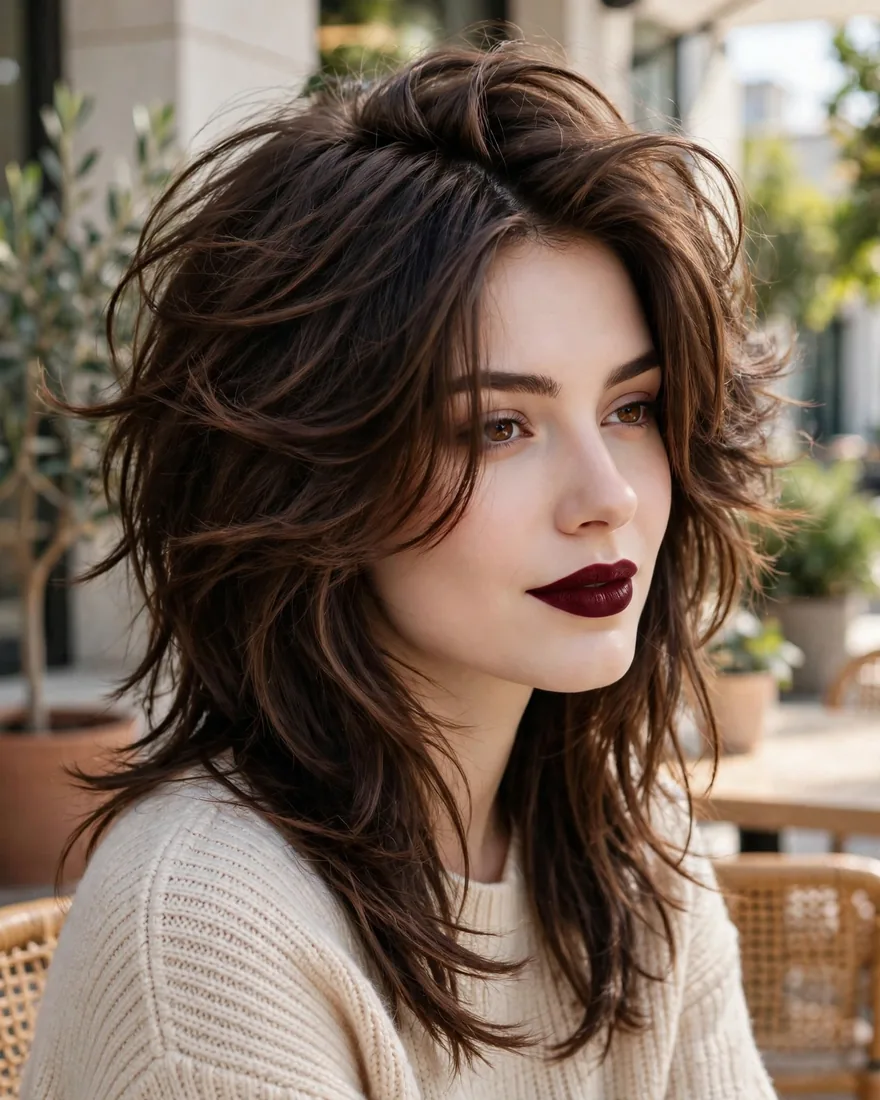
A rule-breaker: swept from a deep side part instead of the center, the longer side draping across the forehead like a curtain pulled to one side while the shorter side blends into the layers. The answer for anyone whose cowlick makes a center part genuinely impossible — no more fighting your growth pattern every morning.
- Benefits: Works with a natural side part instead of against it; the asymmetric drape adds drama; it is a good corrective option if your center-part version grew out unevenly.
- Pro Tip: Commit to the side for two weeks of root training — flip-flopping parts daily trains the hair to lie in neither direction.
- How To Style: Blow-dry the bangs over to the heavy side with a round brush; once dry, finger-coax the drape so the longer side sweeps across and the shorter side tucks behind the ear.
- Best For: Stubborn side-part cowlicks; round faces (the diagonal line is slimming); anyone bored of the center-part look.
11. Feathered 70s Wolf Cut with Curtain Bangs
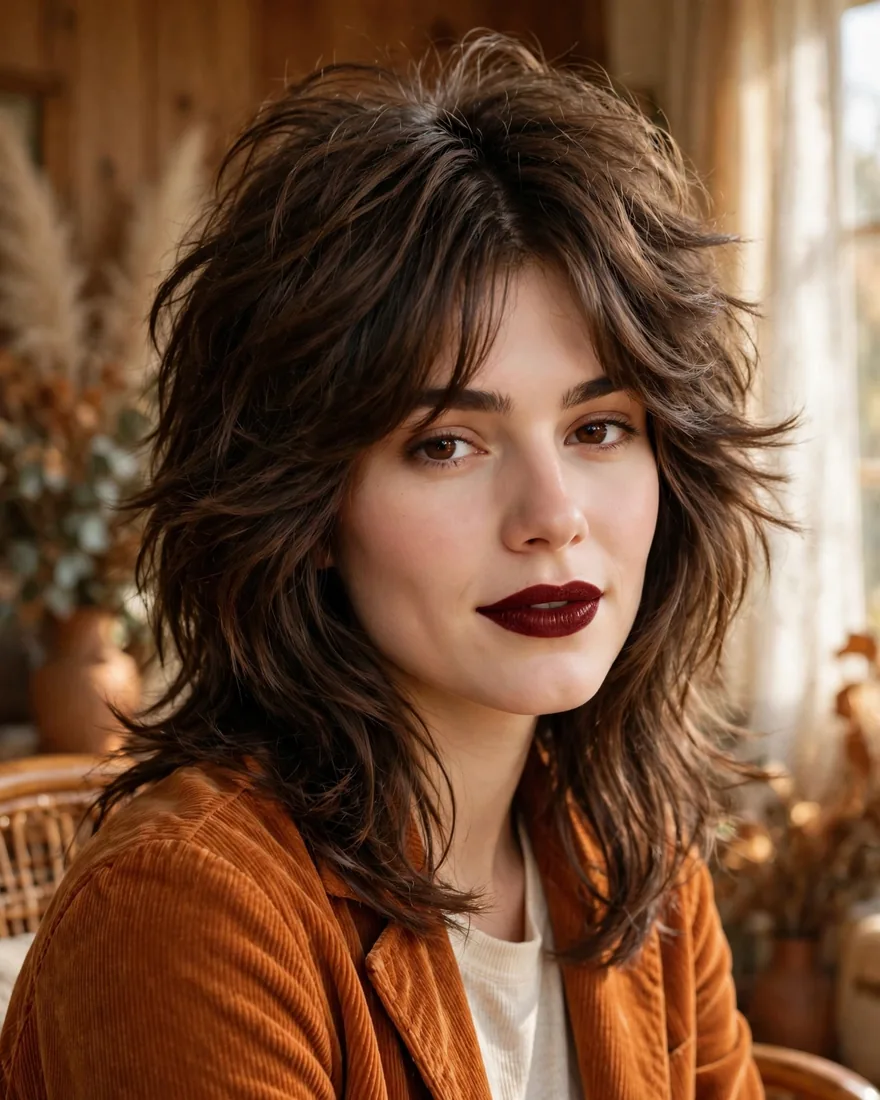
The heritage version: full 70s feathered style, long outward-flipping layers, and a soft sweeping curtain nodding to the decade that invented it. The feathering technique — ends cut at a sharp angle so they flick outward — gives the drape a winged, airy quality no modern texture replicates. Romantic, slightly retro, surprisingly wearable.
- Benefits: The outward flick opens up smaller features; it suits medium to long lengths where the feathering has room to move; the retro finish hides uneven growth.
- Pro Tip: Feathering needs a sharp razor or very sharp shears — ask which your stylist uses, because dull tools chew the ends and kill the flick.
- How To Style: Blow-dry with a medium round brush, rolling the bangs and front layers outward and away from the face. A flexible-hold hairspray keeps the feathered flick.
- Best For: Oval and long faces; medium-density hair with some natural body; vintage-lovers who want the reference, not a costume.
12. Fine-Hair Volume Wolf Cut with Curtain Bangs
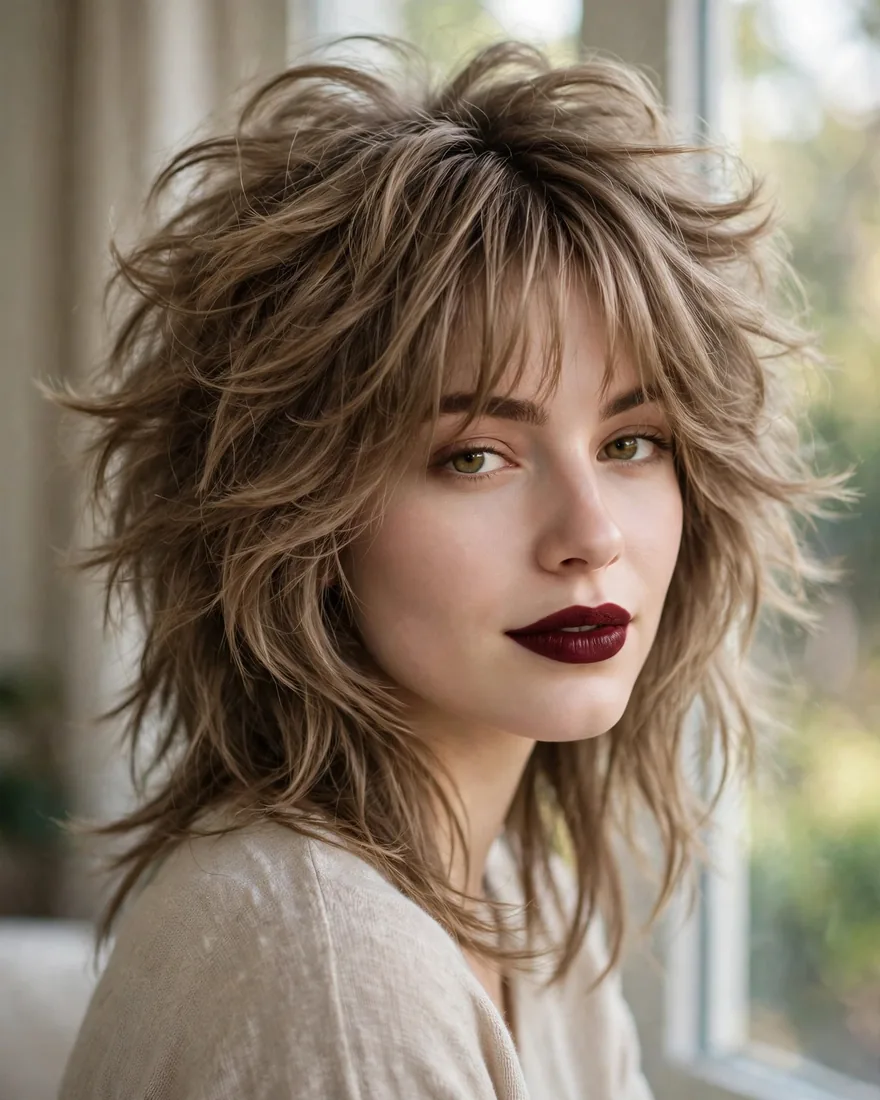
Fine hair and curtain bangs can be sad — or great, depending entirely on the cut. This version is engineered for fine hair: shorter crown layers build volume the hair cannot make on its own, the bangs stay light rather than dense, and blunt ends avoid see-through wisps. The honest limit: root product every single day, no exceptions.
- Benefits: Short crown layers create volume fine hair cannot get from length; light bangs don’t collapse like heavy fringe; blunt ends make fine hair look thicker instantly.
- Pro Tip: Fine-hair bangs should be cut slightly longer and thinner than you want — dense short bangs separate into strands by noon.
- How To Style: Apply volumizing mousse at damp roots, blow-dry the crown upward with your fingers for lift, then round-brush the bangs outward. A light dry-texture spray (never heavy wax) finishes it.
- Best For: Fine, low-density hair; oval and heart faces. A blonde wolf cut with bangs can add visual fullness for fine hair too, since lighter shades reflect more light.
13. Thick-Hair Movement Wolf Cut with Curtain Bangs
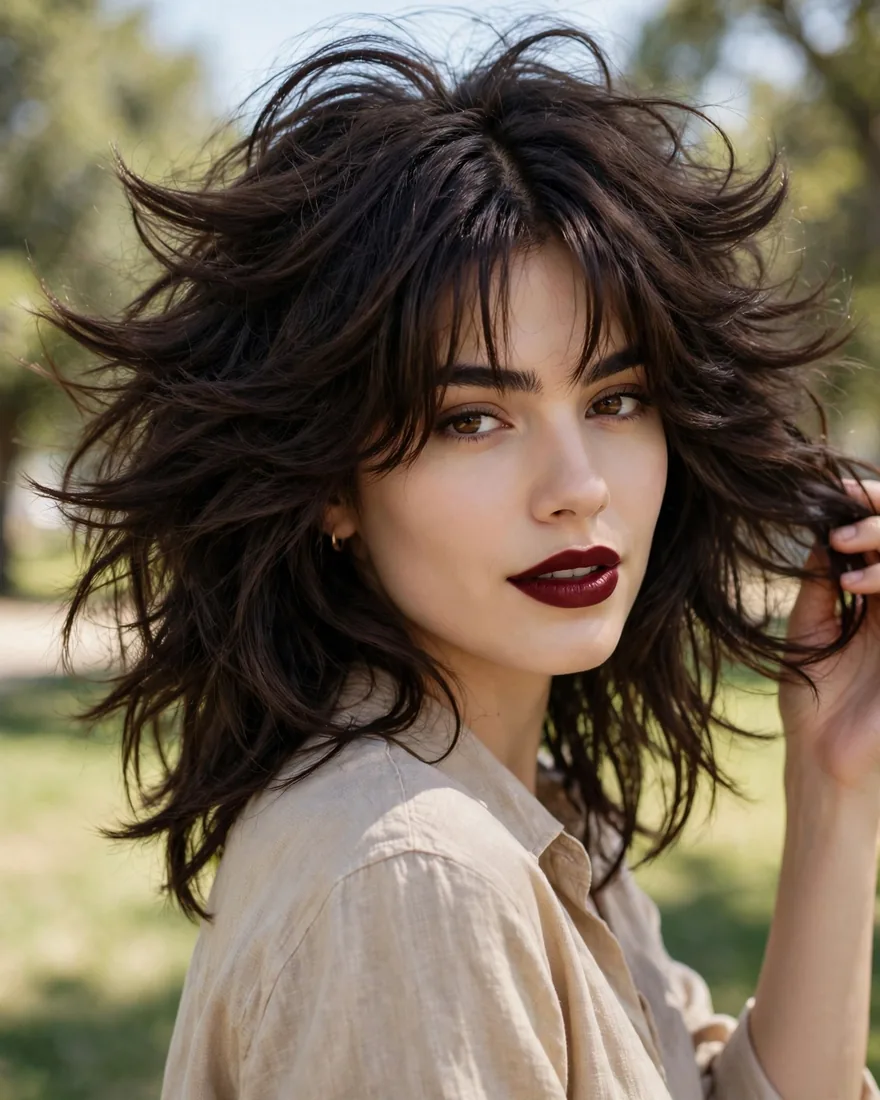
Thick hair’s enemy is the helmet, and this cut is one of the best helmet-breakers available. This version removes serious internal weight so thick hair can actually move, and the bangs are thinned enough to drape rather than puff. The result swings instead of sitting — but it needs a stylist who is not afraid to take out a lot of bulk.
- Benefits: Weight removal lets thick hair move; thinned bangs drape instead of ballooning; the shape holds for weeks because thick hair grows into it.
- Pro Tip: If your stylist offers to “just layer it” without internal thinning, walk away — surface layers on thick hair create the shelf, not the drape.
- How To Style: Blow-dry in sections to control the bulk, directing the bangs outward from the center part. Smoothing cream on the mid-lengths tames frizz while texture spray keeps the ends piecey.
- Best For: Thick, high-density hair; round and square faces (movement slims); anyone whose hair currently eats hair ties. Our shaggy wolf cut with bangs guide covers more weight-removal strategies for thick hair.
How to Choose the Right Wolf Cut with Curtain Bangs for Your Face Shape
The center-parted drape adapts to most faces, but it is not universal — and honesty here saves you a grow-out. Oval faces can wear any of the 13 versions. Heart faces do best with bangs that start lower and drape longer, since short bangs emphasize a wide forehead against a narrow chin. Round faces need the opposite: longer bangs and layers for vertical lines, not width at the cheeks. Square faces benefit from the choppy or wispy versions, which break up hard jawlines better than the sleek one.
Two honest exceptions: very long, narrow faces should avoid the longest versions — the short crop is the flattering fix. And prominent cowlicks at the hairline make the center part a daily battle; either commit to the deep side-part version or accept a two-minute training routine each morning. Bring three photos and point to the exact fringe length — “curtain bangs” means wildly different things to different stylists, and the photo translates.
Face shape is only half the equation — density matters just as much. Fine hair needs the volume-engineered version; thick hair needs the weight-removed version; and medium hair, frankly, can pick by vibe alone. If you are still exploring the broader wolf cut family, our classic wolf cut breakdown maps every variation.
Common Mistakes to Avoid with Curtain Bangs
The most expensive mistake is also the most common: bangs cut too short. They shrink as they dry and spring up with styling, so anything cut to “forehead length” wet lands two inches higher dry. Always ask for longer than your target, and never let a stylist cut them blunt across — a blunt cut cannot part down the middle without a visible shelf. If a cut comes out too short, resist evening it out by cutting more; pin them back and wait two weeks.
The second mistake is the bedhead surrender: waking up with a flattened drape and deciding the cut “doesn’t work.” Curtain bangs almost never survive the night intact — that is normal, not a failure. The fix is a ninety-second morning reset: dampen just the fringe, blow-dry it forward, then sweep it into the part. Day-two refresh works the same way; dry shampoo the roots before they look oily, not after.
Third: the pulled-back conflict. This cut in a ponytail or gym bun leaves the fringe out front — which looks great, but sweat turns bangs stringy during workouts. The practical answer is a soft headband or pinning the fringe up for exercise and resetting after. Finally, respect the trim schedule: a dusting every 3–4 weeks keeps the drape landing right. Many salons do fringe trims cheaply or free between full cuts — ask, because growing past the sweet spot turns the curtain into a curtain rod.
FAQs
How long does this haircut take to style every morning?
Plan for 5 to 15 minutes. The wavy and choppy versions are wash-and-go at around five minutes; the classic and sleek ones need 10 to 15 minutes of blow-drying. The bangs themselves take about two minutes — dampen, blow-dry forward, sweep into the part. Zero-effort mornings call for the wispy entry version.
How much does this cut cost, including upkeep?
A full cut costs the same as any layered cut. The surprise is the fringe: curtain bangs need a trim every 3 to 4 weeks, and many salons charge a small fee for fringe-only visits — ask if they are free between full cuts, since a year of them adds up. Colored versions add toner refreshes on top.
Will curtain bangs work if my forehead is small?
Yes — keep them longer. Short curtain bangs on a small forehead crowd the face. The long airy or wispy versions, with the drape grazing the cheekbones, suit smaller foreheads far better. Tell your stylist to start the shortest point at or below the cheekbones.
Can I pull this haircut into a ponytail or gym bun?
Yes — the bangs stay out front and frame the face while the rest goes up, which looks intentional. For workouts, sweat makes the fringe stringy fast; pin or headband the bangs up and do the ninety-second damp reset after. Shorter crown layers slipping out of the tie only adds to the look.
How often do curtain bangs need a trim?
Every 3 to 4 weeks. Curtain bangs have a sweet spot, and past it they stop parting cleanly and fall into your eyes. Do not trim them yourself with kitchen scissors — an uneven snip shows on a center part more than anywhere else. Book before it bothers you, not after.
What should I ask for at the salon so the bangs don’t come out too short?
Say “cut them longer than the photo” and mean it. Bring a photo, point to the shortest point of the bangs, and ask for one inch below that line dry — hair springs up as it dries. Ask for an angled cut, not blunt, so they drape. And ask to see them styled before you leave the chair.
Do curtain bangs work on curly hair?
They do — but only when cut dry, curl by curl, and left significantly longer to account for shrinkage. Wet-cut curly curtain bangs are the fastest route to a too-short triangle. Find a curl-specialist stylist, and know that wash-day technique (cream on soaking-wet hair, no touching while drying) matters more than the cut itself.
How do I fix bedhead curtain bangs without washing my hair?
Dampen just the fringe, blow-dry it forward and down against the cowlick for ten seconds, then sweep it into the center part. Ninety seconds total. If the part has collapsed, a little dry shampoo at the roots before restyling gives grip. This reset works two to three days between washes.
The right version matches your mornings, not just your mood board. Pick the one that fits your real styling time, your hair’s density, and a fringe length your stylist can actually cut — longer than the photo, angled never blunt. Do that, and the drape stops being a project and starts being the easiest part of your day.