
Shaggy Wolf Cut With Bangs – 13 Cool Ideas for 2026
You know the haircut that looks incredible on everyone else and slightly wrong on you? That is usually a shag gone rogue. You ask for “choppy layers,” the stylist hears “take off the weight,” and you leave with hair that is somehow both flat and frizzy — a cut with no plan. A shaggy wolf cut with bangs is the opposite of that accident. It borrows the wolf cut’s crown volume and tapered ends, roughs them up with true shag texture — piecey, choppy, lived-in — and anchors the whole thing with bangs, so the front always has intention even when the rest is deliberately undone.
Below are 13 ideas worth taking to your stylist: short and long versions, every bang type that actually works with this cut, honest face-shape and hair-density guidance, the shag-vs-wolf-vs-mullet breakdown nobody else gives you, salon language that gets you the right result, grow-out timelines, and answers to the questions everyone asks before committing to bangs. Every idea is chosen for real hair and real routines — the kind where you have ten minutes, not an hour.
Table of Contents
- 13 Shaggy Wolf Cut Ideas That Fit Real Life
- 1. Classic Curtain-Bang Shaggy Wolf Cut
- 2. Wavy Texture Shaggy Wolf Cut
- 3. Short and Edgy Shaggy Wolf Cut
- 4. 70s-Inspired Layered Shaggy Wolf Cut
- 5. Asymmetrical Shaggy Wolf Cut
- 6. Tousled Bedhead Shaggy Wolf Cut
- 7. Wispy Korean Bangs Shaggy Wolf Cut
- 8. Blunt-Bang Contrast Shaggy Wolf Cut
- 9. Micro Bangs Shaggy Wolf Cut
- 10. Long Layered Shaggy Wolf Cut
- 11. Curly Shaggy Wolf Cut
- 12. Fine-Hair Shaggy Wolf Cut
- 13. Chocolate Brown Shaggy Wolf Cut
- Shaggy Wolf Cut vs Shag vs Mullet: What You Are Actually Getting
- How to Choose the Right Shaggy Wolf Cut for Your Face Shape and Hair
- Salon Language and Grow-Out: What to Ask For
- FAQs
- What is the difference between a shaggy wolf cut and a regular shag?
- Will a shaggy wolf cut work on fine hair?
- How do I ask my stylist for a shaggy wolf cut with bangs?
- How often does a shaggy wolf cut need trimming?
- Can I get a shaggy wolf cut with bangs if I have curly hair?
- Does a shaggy wolf cut suit a round face?
- How do I style a shaggy wolf cut at home?
- Will the bangs grow out awkwardly?
13 Shaggy Wolf Cut Ideas That Fit Real Life
1. Classic Curtain-Bang Shaggy Wolf Cut

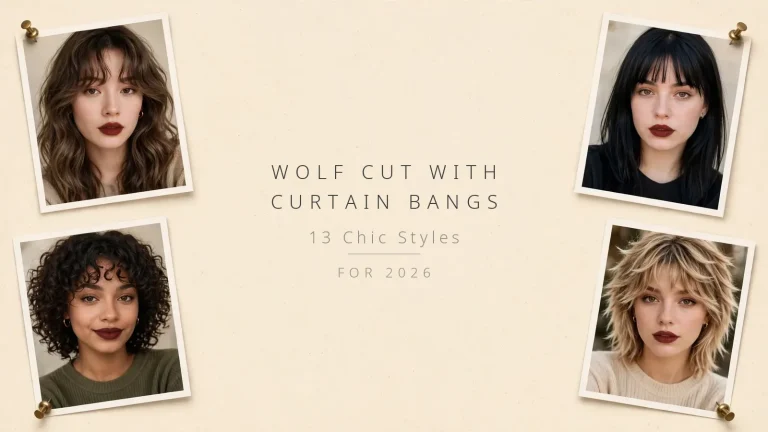
The gateway version of the shaggy wolf cut with bangs, and still the most requested. Curtain bangs part softly in the middle and melt into choppy face-framing layers, while the back keeps the wolf cut’s signature volume up top and piecey, tapered ends. It reads polished from the front and undone from every other angle — the exact tension that makes this cut work.
- Benefits: the most forgiving grow-out of any bang type; softens a strong jawline and wide forehead without hiding your face; works on straight, wavy, and loose-curly textures.
Pro Tip: ask for the curtain bangs to be cut slightly longer than you think — cheekbone-grazing rather than eye-grazing. They shrink up as the texture of your shaggy wolf cut with bangs sets in over the first week.
How To Style: rough-dry with your fingers, then wrap the two front sections around a round brush away from your face for ten seconds each. A pea-sized amount of texturizing cream on the ends keeps the pieces separated instead of fluffy.
Best For: oval, heart, and square face shapes; medium to thick density hair that can hold the choppy layers without collapsing.
2. Wavy Texture Shaggy Wolf Cut
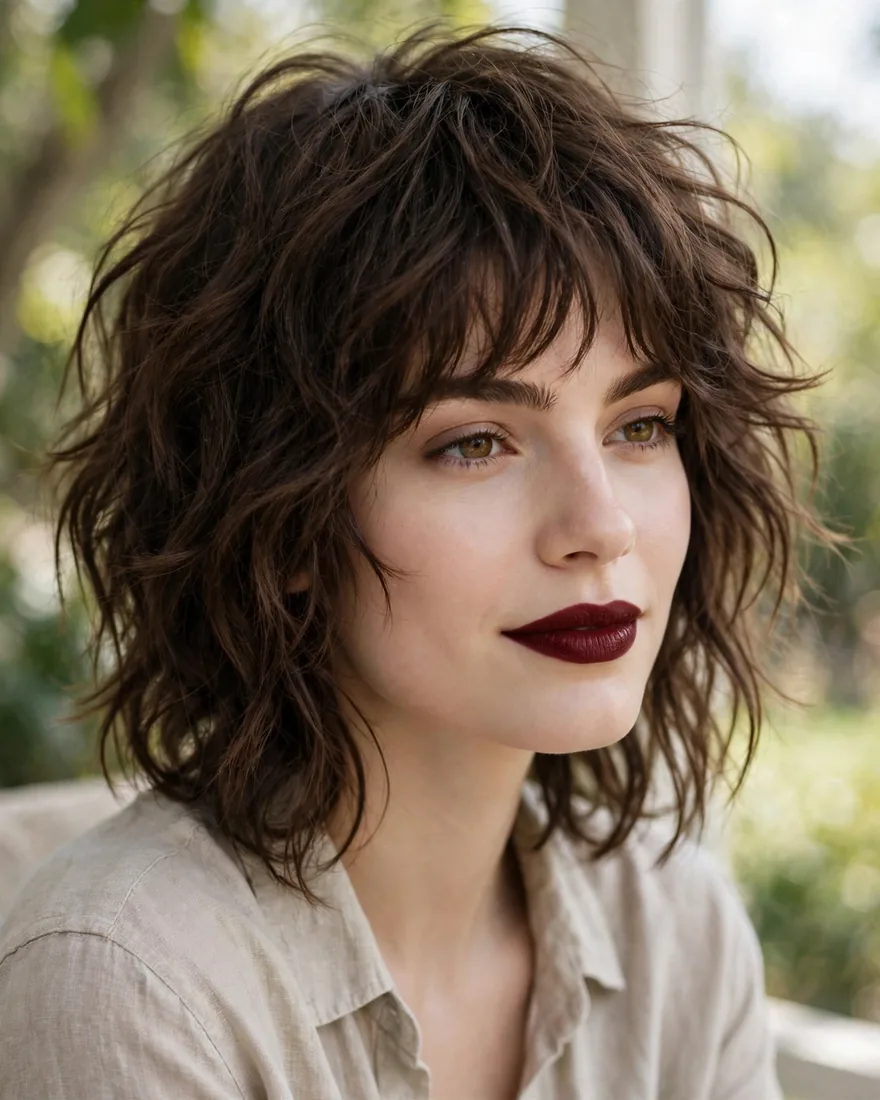
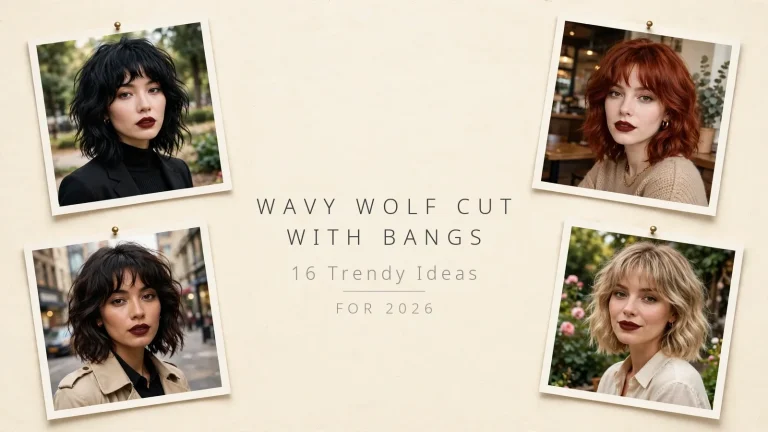
If your hair has a natural wave, this shaggy wolf cut with bangs is the version that finally stops fighting it. The shaggy wolf cut’s internal layers are cut to follow your wave pattern instead of chopping across it, so each wave gets room to form its own piece. The result looks like you styled it for twenty minutes when you actually just scrunched and left.
- Benefits: enhances natural 2A–2C waves instead of suppressing them; the shaggy ends prevent the dreaded triangle shape; air-dries beautifully on most wavy hair.
Pro Tip: have your stylist cut it dry or on your natural wave pattern. Wet-cutting wavy hair for a shaggy wolf cut almost always ends up shorter and choppier than planned once it dries.
How To Style: apply a light mousse to damp hair, scrunch upward, and either diffuse on low heat or air-dry. Once dry, shake at the roots — never brush, which turns shaggy texture into frizz.
Best For: naturally wavy hair of any face shape; medium density is the sweet spot, though thick wavy hair works with extra internal weight removal.
3. Short and Edgy Shaggy Wolf Cut
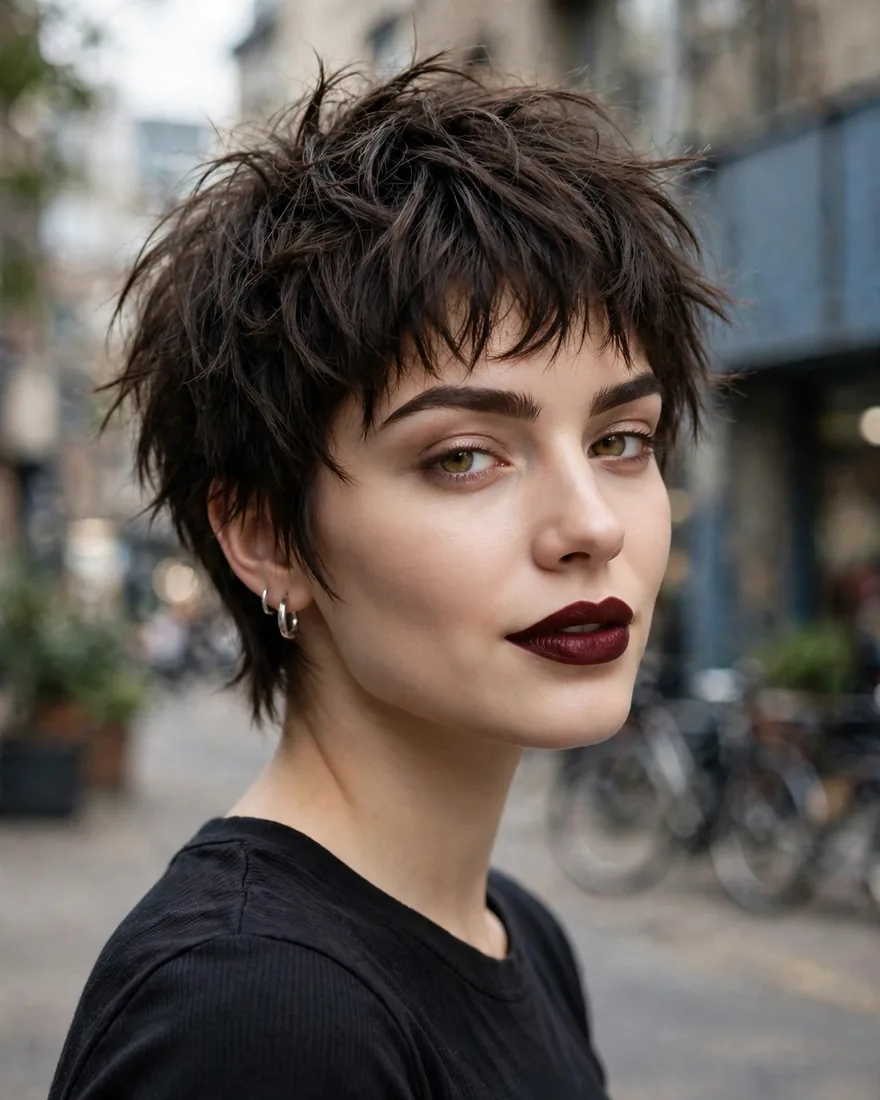
Chin-to-neck length, maximum attitude. The short shaggy wolf cut with bangs concentrates all the choppy texture around the jaw and ears, with bangs that hit anywhere from the brow to the cheekbone depending on how bold you feel. It is the highest-contrast version — every layer is visible, nothing hides — which is exactly why it photographs so well.
- Benefits: makes fine hair look dramatically thicker by stacking texture where the eye lands; dries in minutes; grows out into a great medium shag rather than an awkward in-between.
Pro Tip: at this length, the nape matters more than you think. Ask for the back to be tapered close rather than blunt — a heavy baseline at the nape kills the edgy, flicked-out silhouette.
How To Style: work a small amount of matte paste through dry hair, twisting random pieces in different directions. Flat-iron just the very ends outward for that flicked shag finish. If you like this length, the short wolf cut with curtain bangs is its softer cousin worth comparing.
Best For: oval and heart faces; fine to medium density — the stacked layers create fullness where short hair needs it most.
4. 70s-Inspired Layered Shaggy Wolf Cut
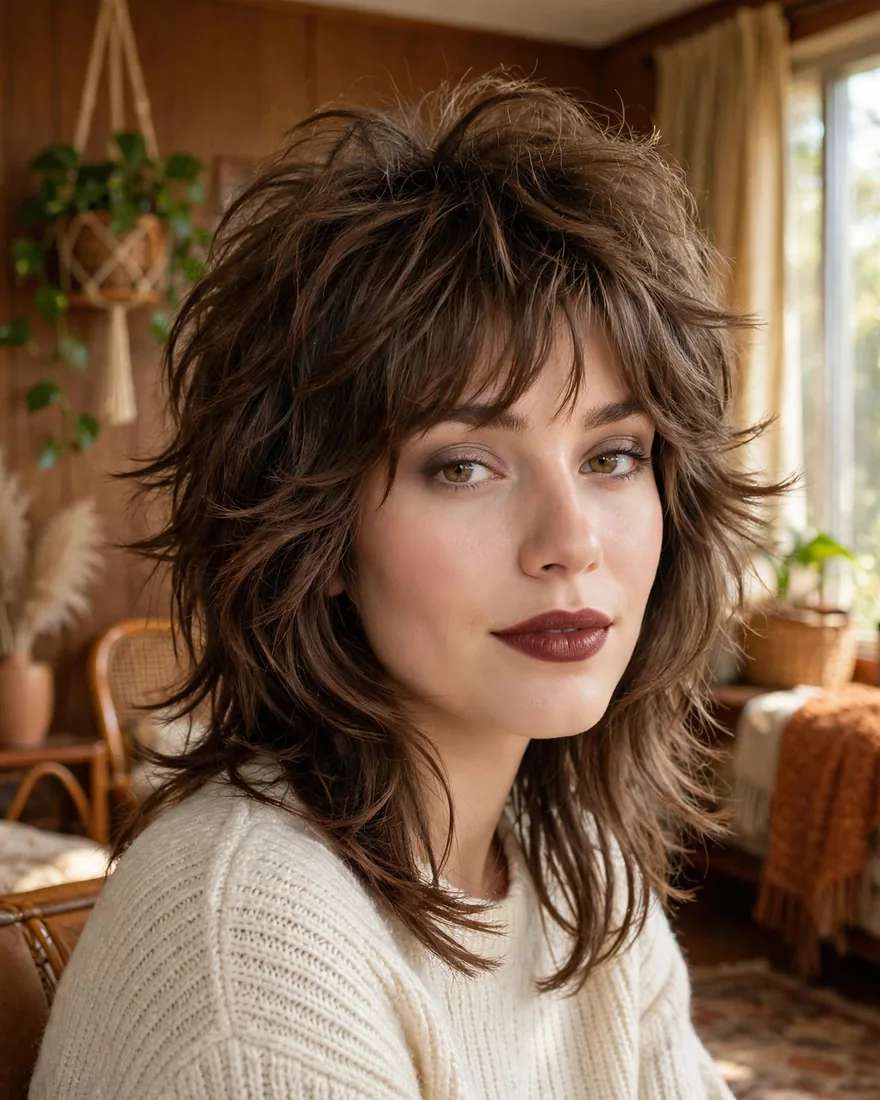
The heritage version of the shaggy wolf cut with bangs — long, feathered, and unapologetically retro. Think cascading layers that flip and curve like the classic 70s shag, but with the wolf cut’s fuller crown keeping it modern instead of costume. The bangs are typically long and curtain-like, blending into the face frame so the whole cut moves as one continuous shape.
- Benefits: incredibly flattering on long faces, which the horizontal movement visually shortens; the feathered ends make thick hair feel lighter; timeless rather than trendy, so it will not date your photos.
Pro Tip: the 70s finish lives or dies on the blow-dry. If you will not round-brush or use hot rollers at least sometimes, choose a more wash-and-go shaggy wolf cut with bangs idea from this list instead.
How To Style: blow-dry with a large round brush, flipping sections outward at the ends. Velcro rollers at the crown for ten minutes while you do makeup give that authentic bouncy 70s lift.
Best For: oblong and oval faces; medium to thick density — fine hair can look straggly at the long feathered ends.
5. Asymmetrical Shaggy Wolf Cut
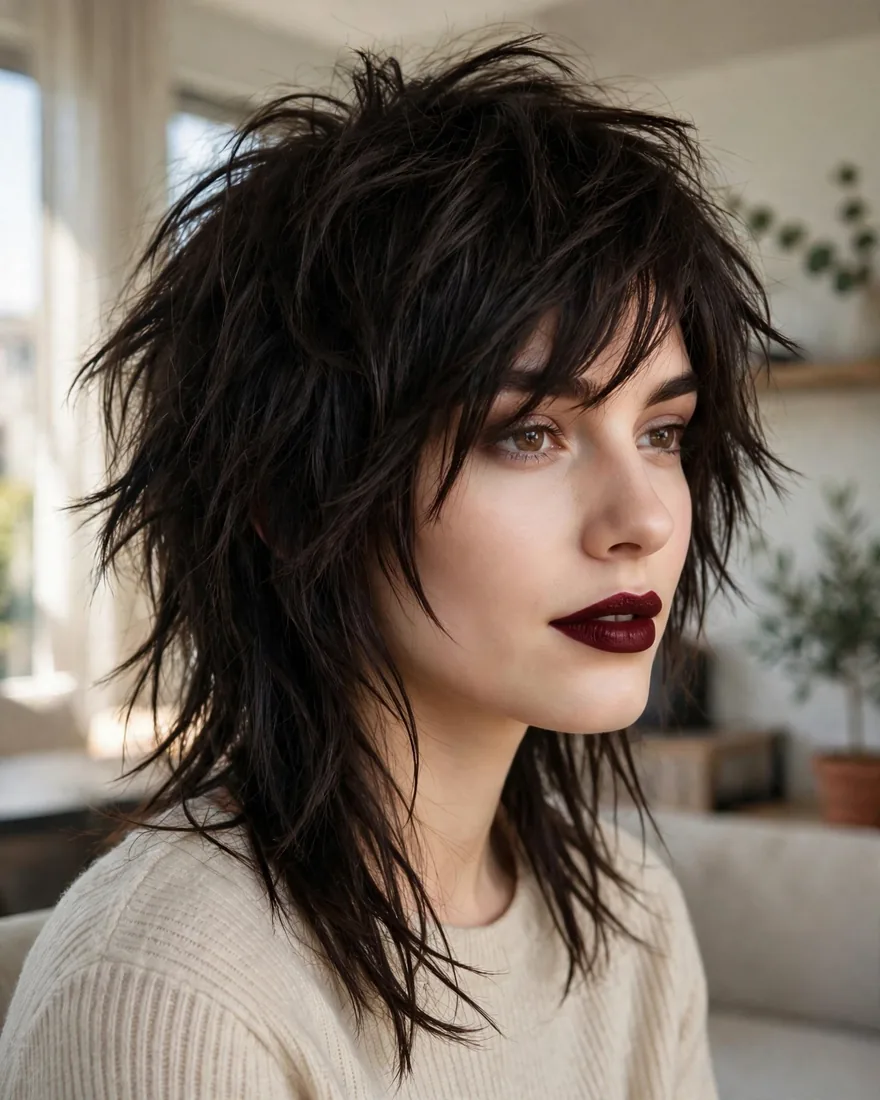
One side grazes the jaw, the other drops toward the collarbone — deliberate imbalance that makes the shaggy wolf cut with bangs feel editorial instead of casual. The asymmetry works with the cut’s choppy DNA rather than against it, because uneven lengths just read as more texture. Keep the bangs soft and brow-skimming to balance the drama happening at the perimeter.
- Benefits: slims a round face by breaking up its symmetry; hides one-sided cowlicks and growth patterns beautifully; unmistakably intentional — nobody mistakes this for a bad haircut.
Pro Tip: keep the length difference to about two inches maximum. Go further and maintenance becomes a constant battle, since the short side grows out noticeably faster in appearance.
How To Style: tuck the shorter side behind your ear to show off the asymmetry, and let the longer side fall forward. A flat iron bent slightly at the ends emphasizes the uneven line. Pair it with a wolf cut with curtain bangs finish on the fringe for the softest version of this bold shape.
Best For: round and square faces that benefit from diagonal lines; medium to thick density so both sides hold their shape.
6. Tousled Bedhead Shaggy Wolf Cut

The “I woke up like this” version, except you actually did something — just not much. This is the shaggy wolf cut with bangs at its most relaxed: layers cut to fall apart naturally, bangs left piecey rather than smoothed, and styling that stops at salt spray and a scrunch. It suits the person whose idea of a routine is dry shampoo and confidence.
- Benefits: the lowest-maintenance idea on this list; second-day hair genuinely looks better than first-day; hides regrowth and faded color better than any polished cut.
Pro Tip: bedhead still needs a good cut underneath. For a shaggy wolf cut with bangs, the difference between intentional tousle and actual mess is internal layering — without it, bedhead just looks unbrushed instead of cool.
How To Style: spray sea salt spray on damp or dry hair, scrunch, and twist a few random pieces around your finger. Sleep on it and refresh with dry shampoo at the roots in the morning.
Best For: all face shapes; wavy to straight medium-density hair — very thick hair can turn this into volume overload without thinning.
7. Wispy Korean Bangs Shaggy Wolf Cut
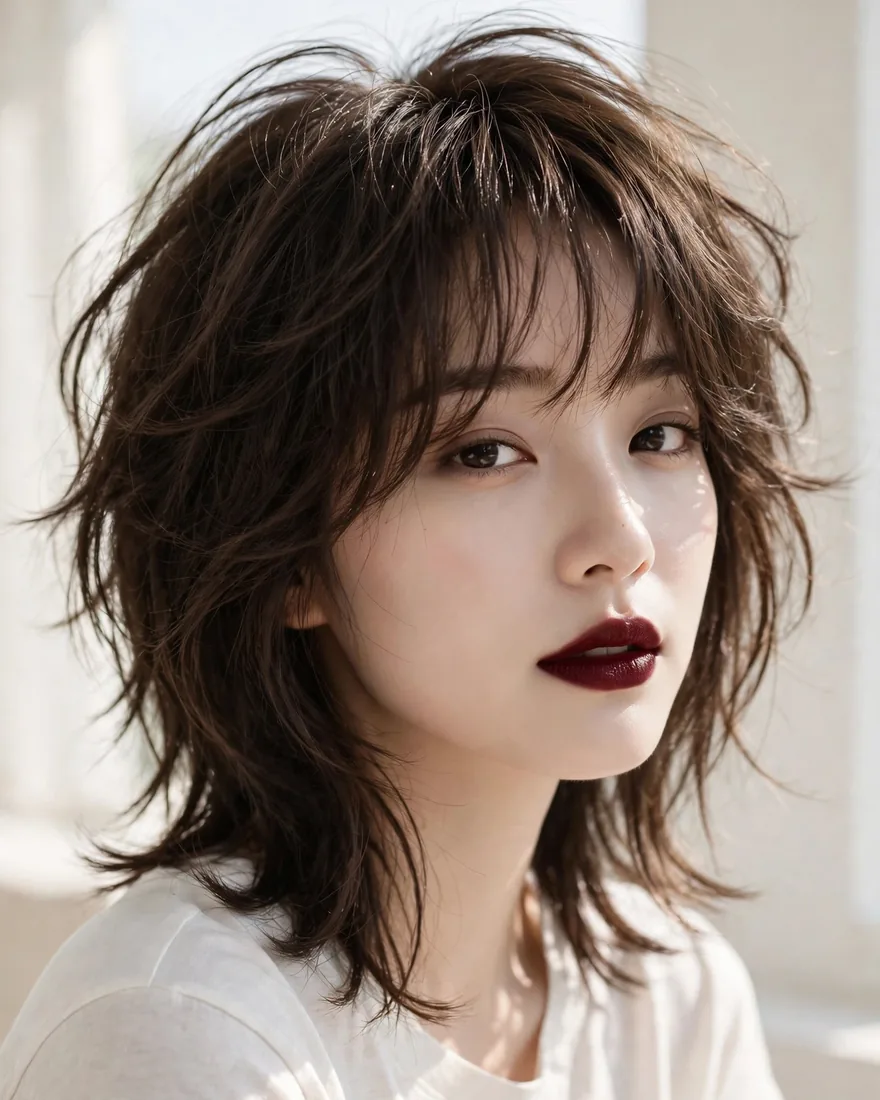
Featherlight, see-through bangs paired with the piecey texture of a shaggy wolf cut with bangs — the softest possible take on the trend. Korean-style wispy bangs sit longer and more transparent than Western fringe, which keeps the cut wearable even if full bangs usually overwhelm your face. The contrast between the airy fringe and the choppy layers is what makes it interesting.
- Benefits: the least committing bang option — grows out with almost no awkward stage; flatters small foreheads that cannot carry heavy fringe; adds softness that balances the cut’s edge.
Pro Tip: wispy bangs and oily skin are a tricky pair. Keep blotting papers or a travel dry shampoo handy, because these bangs show oil faster than any other type on this list.
How To Style: blow-dry the bangs downward with a small round brush, then pinch them into pieces with the tiniest amount of pomade. The lengths need almost nothing — a wavy wolf cut with bangs styling routine of scrunch-and-go works perfectly here.
Best For: heart and oval faces; fine to medium density — the transparency of the bangs suits hair that is not too heavy.
8. Blunt-Bang Contrast Shaggy Wolf Cut
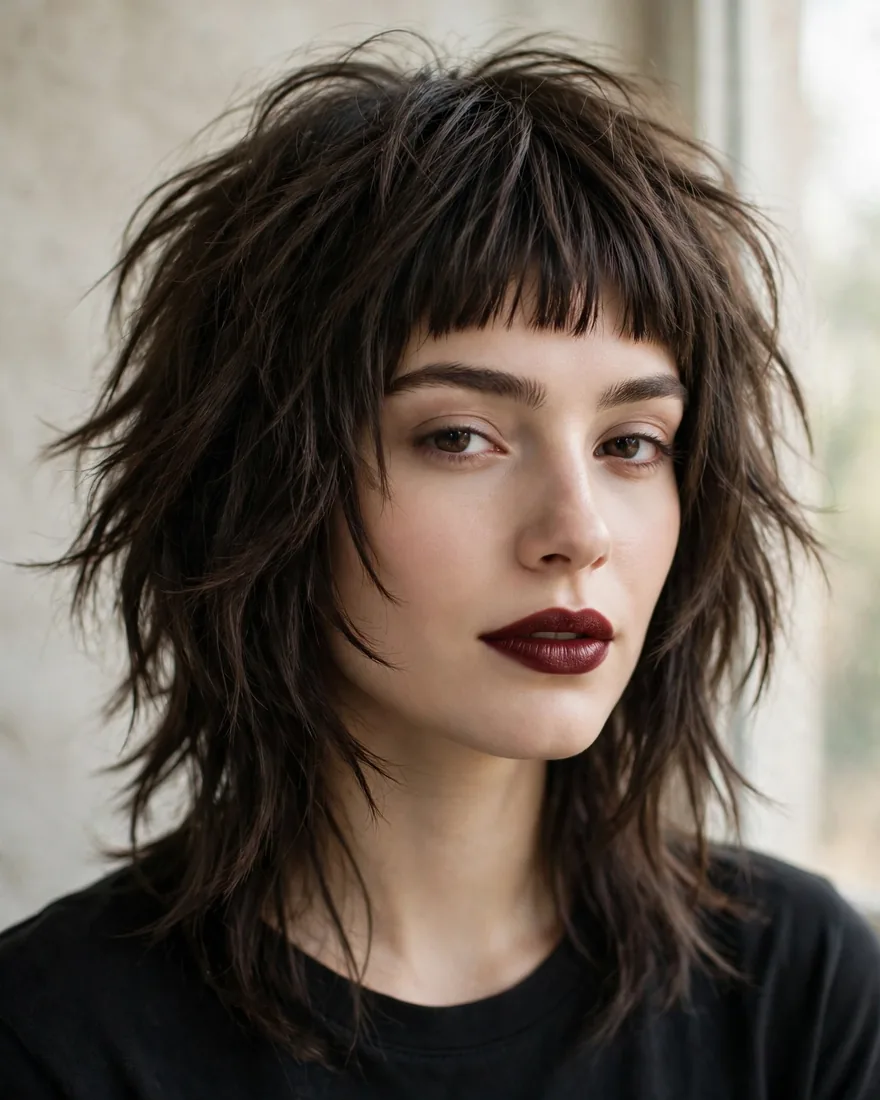
Precision on top, chaos everywhere else. A straight-across blunt fringe against the shattered shaggy layers of a shaggy wolf cut with bangs creates the strongest contrast on this list — graphic and fashion-forward, the kind of cut that gets photographed at fashion week. The bluntness gives the eye somewhere to rest, which actually makes the wild layers look more deliberate.
- Benefits: makes the whole cut look intentional and high-fashion; the strong horizontal line shortens a long forehead dramatically; grows out into a perfect curtain bang with zero awkward phase.
Pro Tip: blunt bangs need trimming every three to four weeks to keep their edge — the only high-maintenance fringe on this list. If that sounds like too much, the curtain version (idea 1) gives you 80 percent of the look.
How To Style: flat-iron the bangs smooth and straight, then deliberately rough up everything else on your shaggy wolf cut with bangs with texturizing spray. The contrast between sleek fringe and messy lengths is the entire point — do not blend them.
Best For: oval and oblong faces; thick, straight to slightly wavy hair that can hold a crisp bang line.
9. Micro Bangs Shaggy Wolf Cut
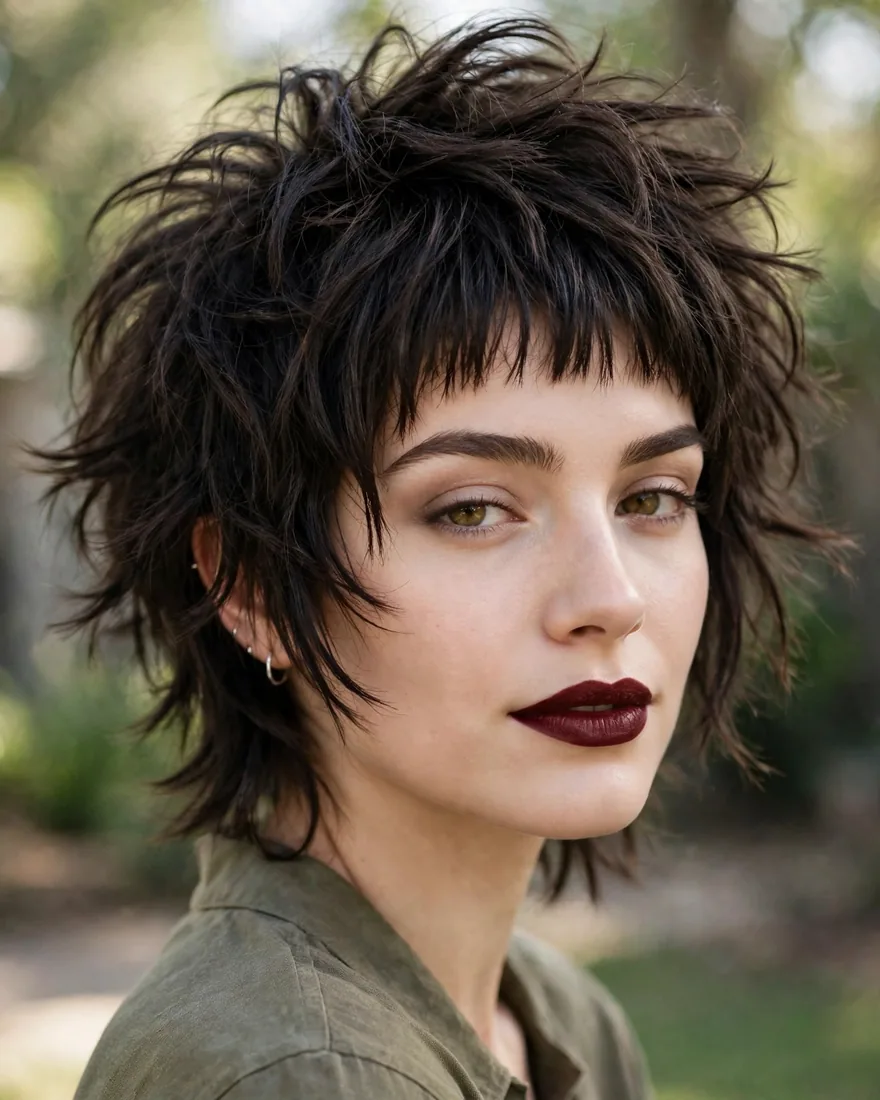
Baby bangs meet rock-and-roll texture. Micro bangs — cut well above the brow — sound extreme, but against the longer, wilder layers of a shaggy wolf cut with bangs they create a striking proportion play: short fringe, long chaos. It is the boldest bang choice here and the one that most clearly signals you meant it.
- Benefits: opens up the face completely — great if you love showing your eyes and brows; makes a long forehead look shorter by breaking it visually; unmistakably edgy without needing color or styling tricks.
Pro Tip: micro bangs expose your forehead shape completely, so be honest about it. They flatter smooth, even foreheads and fight against strong cowlicks — if your hairline swirls, this fringe will too.
How To Style: keep them piecey, not plastered — a tiny bit of wax pinched through is enough. The lengths can go full bedhead; the short fringe keeps the whole look from tipping into unkempt.
Best For: oval and heart faces with smooth hairlines; straight to wavy textures — tight curls will shrink micro bangs unpredictably.
10. Long Layered Shaggy Wolf Cut
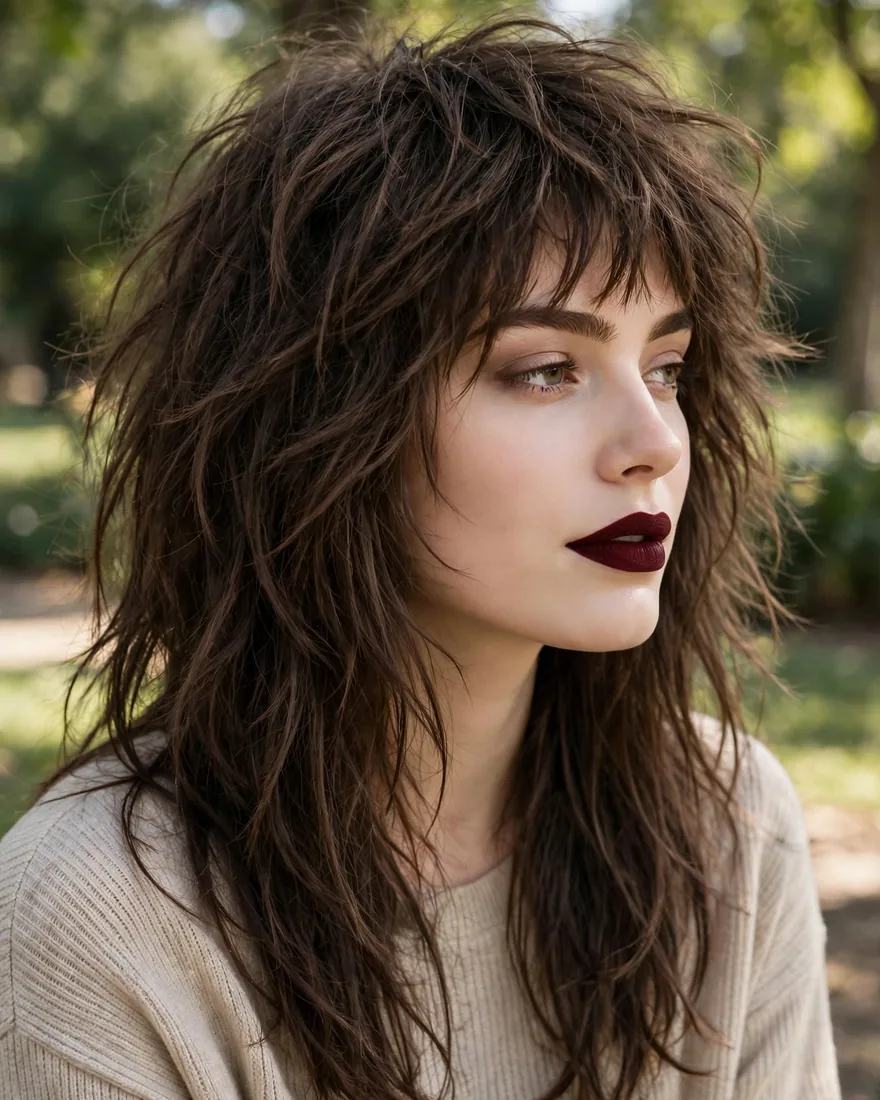
For everyone who wants a shaggy wolf cut with bangs without sacrificing length. The layers start at the collarbone and cascade down, with the wolf cut’s crown volume keeping the top from going flat and the shaggy ends preventing the dreaded one-length curtain of hair. Bangs — usually long and curtain-like — keep it from reading as just “long layered hair.”
- Benefits: the safest entry point if you are nervous about choppy cuts; keeps styling versatility (ponytails, braids, updos all still work); the long layers make thick hair dramatically more manageable.
Pro Tip: the bangs are non-negotiable here. Without them, long shaggy layers just look like grown-out layers — the fringe is what makes it read as a shaggy wolf cut with bangs rather than a regular long cut.
How To Style: blow-dry smooth with a paddle brush for polish, or braid damp hair overnight for waves. Layers this long respond well to hot rollers for big, bouncy movement. For length comparison, long wolf cuts with curtain bangs shows how this silhouette behaves at maximum length.
Best For: all face shapes; thick hair benefits most — the layers remove the weight that makes long thick hair exhausting.
11. Curly Shaggy Wolf Cut

Curls and the shaggy wolf cut with bangs were made for each other — every curl is already a “piece,” so the cut just organizes what your hair wants to do. The wolf cut’s rounded crown prevents the pyramid effect, while curly bangs (cut long and dry) frame the face without the helmet look. This is a specialist cut, so choose your stylist like it matters — because it does.
- Benefits: curls gain definition instead of frizz when the layers follow the curl pattern; wash-and-go friendly once the shape is right; the shaggy silhouette distributes volume evenly instead of widening at the bottom.
Pro Tip: curly bangs must be cut dry, curl by curl, and left at least an inch longer than your target — shrinkage is real and unforgiving. A stylist who wants to cut the fringe of your shaggy wolf cut with bangs wet is a stylist to walk away from.
How To Style: apply curl cream to soaking-wet hair, scrunch, and diffuse or air-dry. Refresh curls on day two with a water-cream mix rather than rewetting fully. Our curly wolf cut guide goes deeper on curl-specific layering if your texture is 3A and above.
Best For: 2C–3C curls; medium to thick density — fine curly hair needs fewer, longer layers to avoid a sparse look.
12. Fine-Hair Shaggy Wolf Cut

The careful exception to the “more layers” rule. On fine hair, a shaggy wolf cut with bangs works beautifully — but only when the stylist resists over-layering. Fewer, well-placed internal layers create the piecey texture without removing the density you cannot afford to lose. The bangs do heavy lifting here, adding visual fullness across the forehead where fine hair looks thinnest.
- Benefits: creates the illusion of thickness through texture rather than volume products; the bangs disguise a sparse hairline; lighter ends mean fine hair actually holds a wave or bend.
Pro Tip: say the words “keep the perimeter strong” at your appointment. If your stylist thins or razors fine hair aggressively for a shaggy wolf cut, the ends go see-through — the exact opposite of what you want.
How To Style: volumizing mousse at the roots, blow-dry upside down, and keep products away from the mid-lengths and ends. A light texturizing powder at the crown adds grip without weight.
Best For: fine, low-density hair on any face shape — this is the version engineered specifically to avoid the stringy trap.
13. Chocolate Brown Shaggy Wolf Cut
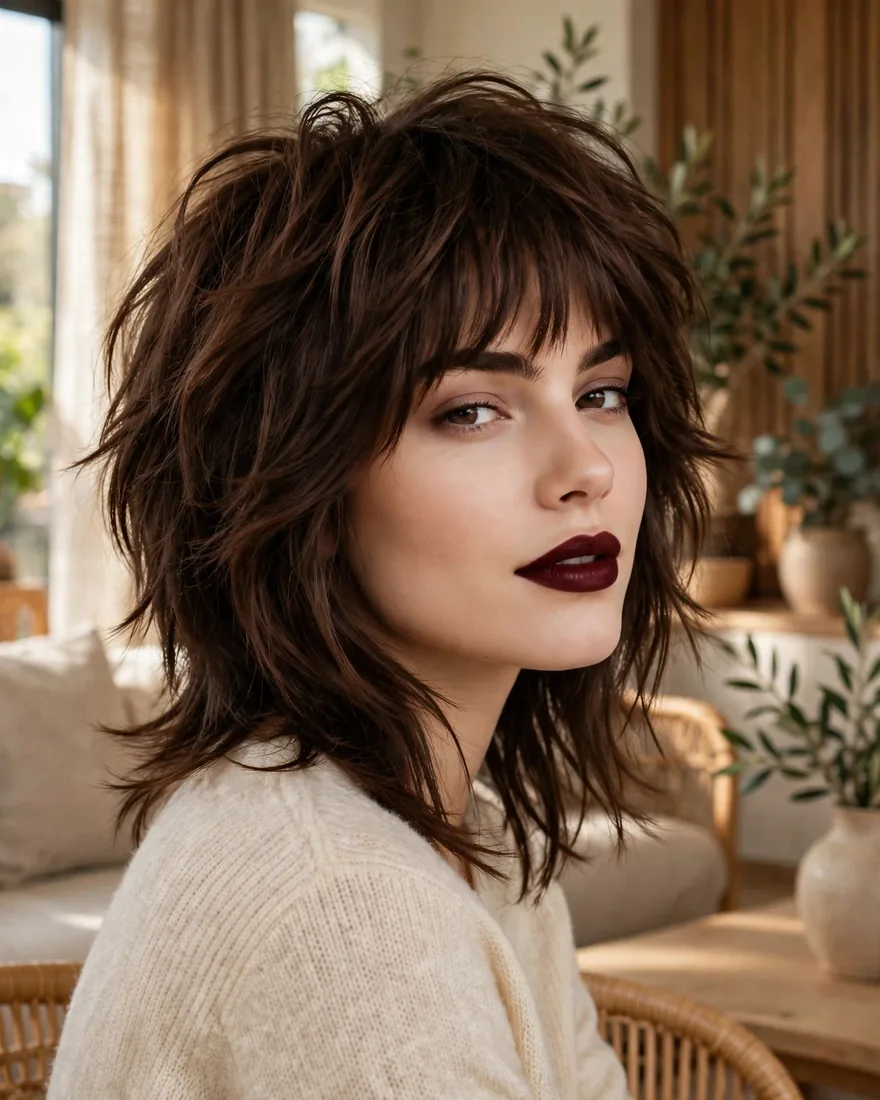
The celebrity proof that this cut is not just for blondes and pastels. Rich, glossy chocolate brown — the shade Cara Delevingne has worn with her shaggy wolf cut with bangs — gives the choppy layers a luxurious depth lighter colors cannot match. Every piecey layer catches light differently on dark hair, so the texture reads even richer.
- Benefits: dark color makes shaggy texture more visible, not less; grows out gracefully with minimal root contrast; universally flattering across skin tones when the brown is matched to your undertone.
Pro Tip: ask your colorist for a chocolate with dimension — a single flat dark brown can make shaggy layers disappear. Subtle balayage or gloss through the mid-lengths keeps each piece defined.
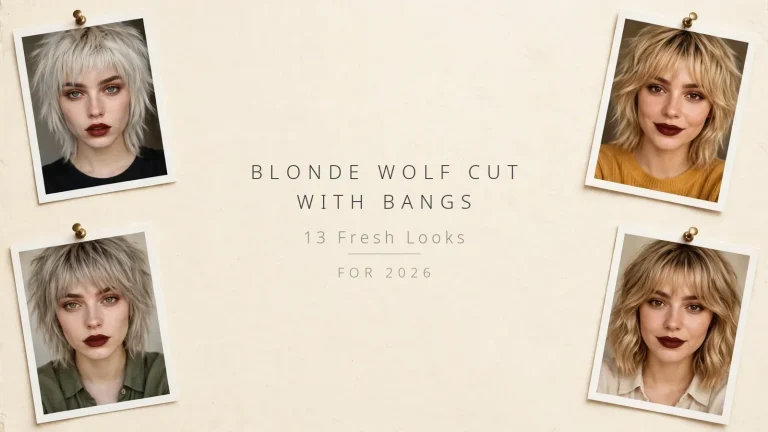
How To Style: shine is everything on dark hair, so finish with a lightweight glossing serum on the ends. Blow-dry the bangs smooth and let the layers stay piecey — polish plus texture is the celebrity formula. If you are torn between dark and light, blonde wolf cut with bangs shows how the same cut behaves at the opposite end of the color spectrum.
Best For: all face shapes and densities; especially striking on thick hair where the color depth amplifies the layering.
Shaggy Wolf Cut vs Shag vs Mullet: What You Are Actually Getting
These three cuts get mixed up constantly — including, honestly, by some stylists — so here is the straight breakdown before you book. A classic shag is choppy, all-over layers with a rock-and-roll feel; the texture is evenly distributed from crown to ends, and the silhouette is roughly the same width top to bottom. A mullet is short in front and long in back with a disconnected jump between the two — the contrast is the point. A shaggy wolf cut with bangs sits between them: it takes the wolf cut’s rounded crown volume and wispy tapered ends, then roughs up the surface with shag-style choppy, piecey texture throughout.
In practical terms: if you want maximum edge and do not mind a visible short-to-long disconnect, the mullet is your cut. If you want even, lived-in texture with no strong shape statement, get the shag. If you want volume up top, piecey ends, and bangs that tie it together — the most wearable of the three for everyday life — the shaggy wolf cut with bangs is the answer. At the salon, use all three words deliberately: “I want a wolf cut base, with shaggy texture through it, and bangs — not a mullet, so keep the front-to-back transition blended.” That one sentence prevents most miscommunication. For the pure, un-shagged base shape, our wolf cut guide breaks down the original silhouette.
How to Choose the Right Shaggy Wolf Cut for Your Face Shape and Hair
Start with honesty about your face shape, because the wrong bang fights your bone structure no matter how good the layers of your shaggy wolf cut with bangs are. Round faces need vertical lines — curtain bangs, long face-framing pieces, or the asymmetrical version (idea 5) — and should avoid short straight-across bangs. Square faces want softness at the jaw: wispy or curtain bangs, never blunt geometric fringe. Heart faces suit nearly every bang here; keep volume at the chin to balance a narrower jaw. Oblong faces should lean into fuller bangs and avoid excessive crown height. Oval faces can wear all 13 — your constraint is hair density, not shape.
Density matters as much as shape. Fine hair needs idea 12’s restrained approach: fewer layers, a strong perimeter, texture from styling rather than cutting — too many layers remove the little density you have and the ends go stringy. Thick hair needs serious internal weight removal and point cutting, or the cut turns into a triangle. Medium density can handle any idea on this list. One honest note: if you are deeply attached to sleek, polished hair, this family of cuts will frustrate you — the shaggy wolf cut with bangs looks best slightly undone. If bangs themselves are the hesitation, the wolf cut without bangs keeps the shape with a grown-out front.
Salon Language and Grow-Out: What to Ask For
Walk in with specifics, not vibes. Say: “I want a wolf cut base — volume at the crown, tapered ends — with shaggy, piecey texture through the whole thing, and [your chosen bang type].” Then add what separates a good result from a random chop: point cutting on the ends (not blunt cutting) for the feathery finish, and razor vs shears — razors give softer texture on medium to thick hair but frizz fine hair, so fine-haired clients should request shears-only. Specify crown layer length (shorter = more volume and edge; longer = softer and safer) versus the nape, which controls how dramatic the silhouette reads from the side.
Grow-out is genuinely kind to the shaggy wolf cut with bangs, which is part of its appeal. Shaggy texture disguises regrowth far better than a blunt cut — expect 8 to 10 weeks before reshaping, with bang trims every 3 to 6 weeks (blunt and micro need the frequent end; curtain and wispy can stretch it). As it grows, the bangs become curtain bangs and the layers settle into a long shag — around month three you have a great grown-out shape, not a mess. The awkward phase mostly applies to the fringe, and even that just means pushing it aside for a week or two.
FAQs
What is the difference between a shaggy wolf cut and a regular shag?
A regular shag has choppy layers distributed evenly from crown to ends with a roughly uniform silhouette, while a shaggy wolf cut with bangs keeps the wolf cut’s distinctive shape — rounded volume at the crown tapering to wispy ends — and adds shag-style piecey texture through it. Think of it as a wolf cut wearing a shag’s texture.
Will a shaggy wolf cut work on fine hair?
Yes, but with restraint. Fine hair needs fewer, carefully placed layers and a strong perimeter — aggressive thinning or razoring makes fine ends look stringy. Idea 12 on this list is engineered exactly for this, and the bangs add visual fullness where fine hair looks thinnest.
How do I ask my stylist for a shaggy wolf cut with bangs?
Say: “I want a wolf cut base — volume at the crown, tapered ends — with shaggy, piecey texture through the whole thing, and [your bang type].” Add: point-cut ends, shears-only if your hair is fine, and specify how short you want the crown layers. Bring two or three photos of the exact idea you want.
How often does a shaggy wolf cut need trimming?
The cut itself holds its shape for 8 to 10 weeks since shaggy texture disguises regrowth well. Bangs need more frequent attention: blunt and micro bangs every 3 to 4 weeks, curtain and wispy bangs every 5 to 6 weeks. Short versions need reshaping sooner than long ones.
Can I get a shaggy wolf cut with bangs if I have curly hair?
Absolutely — curls and shaggy texture are a natural match. The key requirements: a stylist experienced with curly cuts, bangs cut dry and curl-by-curl, and the fringe left at least an inch longer than your target length to account for shrinkage. Idea 11 covers the curly version in detail.
Does a shaggy wolf cut suit a round face?
Yes, with the right bang choice. Round faces need vertical, diagonal lines — curtain bangs, long face-framing pieces, or the asymmetrical version. Avoid short straight-across bangs, which emphasize width. The crown volume of the wolf cut base also adds flattering height.
How do I style a shaggy wolf cut at home?
Keep it simple: mousse or salt spray on damp hair, scrunch, and air-dry or diffuse. Once dry, shake at the roots and pinch random pieces with a tiny amount of paste or pomade. A shaggy wolf cut with bangs is designed to look good slightly undone — over-styling works against it.
Will the bangs grow out awkwardly?
Less awkwardly than with most cuts. Blunt bangs grow into curtain bangs, micro bangs grow into brow-skimming fringe, and wispy bangs barely have a transition at all. The shaggy layers around them disguise every stage, so the grow-out reads as intentional for months.
The shaggy wolf cut with bangs works because it is honest about what it is: texture with a plan. Pick the shaggy wolf cut with bangs idea that matches your face shape and hair density rather than the one with the prettiest photo, learn the five sentences of salon language above, and give the cut two weeks to settle — shaggy texture always looks best once it has lived in your real routine for a few days. Book the appointment; the inspiration photos have waited long enough.